Responsibilities of Medical Lab Technicians
Medical Laboratory Technicians are an essential part of the healthcare system. While patients may not always interact directly with them, the work they perform in laboratories plays a crucial role in diagnosing diseases, monitoring health conditions, and supporting effective medical treatment. From collecting samples to operating sophisticated laboratory equipment, Medical Lab Technicians contribute significantly to quality patient care.
With the growing demand for diagnostic services, skilled laboratory professionals are needed in hospitals, diagnostic centres, research laboratories, and healthcare facilities. This makes Medical Laboratory Technology an excellent career choice for students interested in science and healthcare.
Rajamma Institute of Allied Health Sciences (RIAHS), a unit of Rajamma Medical Foundation (RMF), prepares students for this rewarding profession through practical training, industry-focused education, and career-oriented Diploma and Advanced Diploma programs.
Who Is a Medical Lab Technician?
A Medical Lab Technician (MLT) is a healthcare professional responsible for conducting laboratory tests on blood, urine, tissue, and other biological samples. These tests help doctors detect diseases, monitor treatment progress, and make informed medical decisions.
Medical Lab Technicians work closely with pathologists, doctors, nurses, and other healthcare professionals to ensure laboratory reports are accurate and delivered on time.
Daily Responsibilities of a Medical Lab Technician
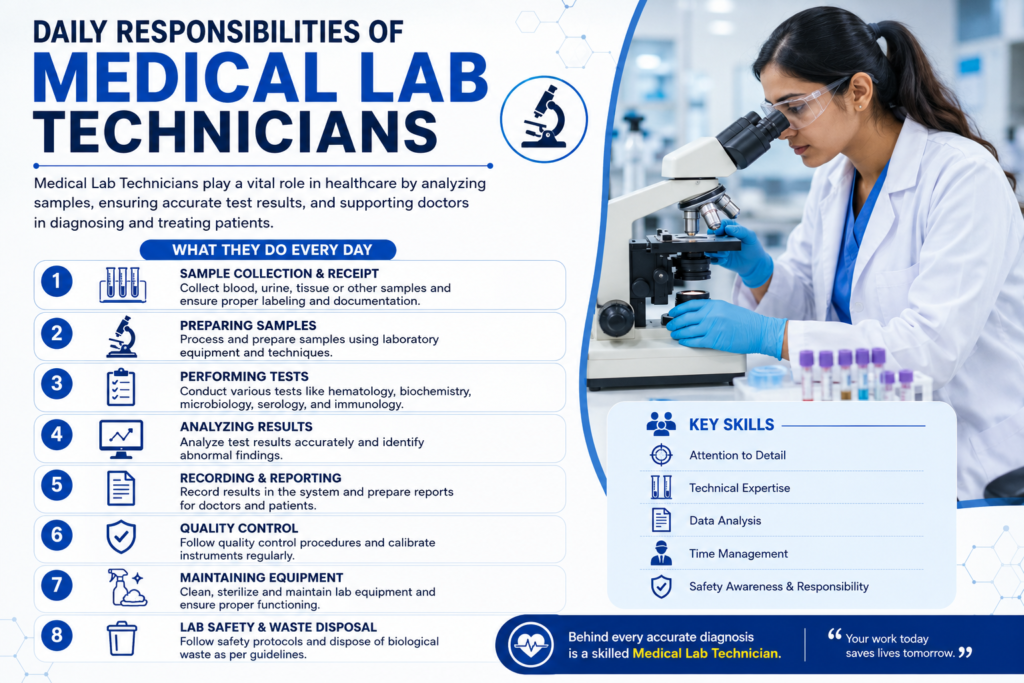
Every day in a medical laboratory involves different tasks that require accuracy, attention to detail, and technical expertise.
Collecting and Preparing Samples
Medical Lab Technicians receive patient samples such as blood, urine, and other specimens. Proper collection, labeling, and preparation are essential to ensure accurate testing.
Performing Diagnostic Tests
Technicians conduct various laboratory tests using standard procedures and modern diagnostic equipment. These tests help identify infections, diseases, and other health conditions.
Operating Laboratory Equipment
Modern laboratories use advanced analyzers, microscopes, centrifuges, and testing machines. Medical Lab Technicians operate, monitor, and maintain this equipment to ensure reliable results.
Recording Test Results
After completing laboratory tests, technicians carefully record findings and prepare reports for doctors and pathologists. Accurate documentation is essential for proper patient care.
Maintaining Laboratory Safety
Following infection control guidelines and laboratory safety protocols helps protect healthcare professionals, patients, and the accuracy of test results.
Skills Required for Medical Lab Technicians
A successful Medical Lab Technician needs both technical knowledge and professional skills.
Important skills include:
- Attention to detail
- Observation skills
- Communication
- Problem-solving
- Time management
- Computer literacy
- Laboratory safety awareness
- Professional ethics
These qualities help technicians work efficiently while maintaining high standards of accuracy.
Practical Training Prepares Students for Success
Healthcare employers prefer graduates who have practical laboratory experience before entering the workforce.
At Rajamma Institute of Allied Health Sciences (RIAHS), students receive hands-on learning through:
- Laboratory practical sessions
- Clinical demonstrations
- Sample analysis training
- Medical equipment handling
- Healthcare skill development
Advanced Diploma students also participate in On-the-Job Training (OJT), where they gain real-world laboratory experience under the supervision of experienced professionals.
This practical exposure helps students develop confidence and become workplace-ready.
Career Opportunities After Graduation
Qualified Medical Lab Technicians have opportunities to work in:
- Multi-speciality Hospitals
- Diagnostic Laboratories
- Clinical Laboratories
- Blood Banks
- Research Laboratories
- Public Health Laboratories
- Healthcare Clinics
- Private Laboratory Services
As healthcare services continue to expand, the demand for skilled laboratory professionals remains strong.
Why Choose RIAHS?
Students choose Rajamma Institute of Allied Health Sciences (RIAHS) because the institute focuses on preparing graduates for successful healthcare careers.
RIAHS offers:
- Career-oriented Diploma and Advanced Diploma programs
- Practical laboratory training
- Clinical demonstrations
- On-the-Job Training (OJT)
- Experienced faculty
- Modern laboratory facilities
- Career guidance
- Placement assistance
This comprehensive learning approach ensures students graduate with the knowledge, practical skills, and confidence required by today’s healthcare industry.
Conclusion
Medical Laboratory Technicians play a vital role in modern healthcare by providing accurate laboratory results that support diagnosis and treatment. Their daily responsibilities require precision, professionalism, and technical expertise, making them valuable members of every healthcare team.
As a unit of Rajamma Medical Foundation (RMF), Rajamma Institute of Allied Health Sciences (RIAHS) prepares students through quality education, practical laboratory training, and career-focused learning. With the right skills and hands-on experience, graduates are well-equipped to build successful careers in the growing field of medical laboratory technology.
Frequently Asked Questions (FAQs)
1. What are the daily responsibilities of a Medical Lab Technician?
Medical Lab Technicians collect and prepare patient samples, perform laboratory tests, operate diagnostic equipment, record results, and maintain laboratory safety standards.
2. Where can Medical Lab Technicians find employment?
They can work in hospitals, diagnostic laboratories, clinical laboratories, blood banks, research centres, and public health laboratories.
3. Does RIAHS provide practical laboratory training?
Yes. RIAHS provides laboratory practical sessions, clinical demonstrations, and On-the-Job Training (OJT) to help students gain real-world laboratory experience.
4. What skills are important for Medical Lab Technicians?
Attention to detail, observation, communication, laboratory safety, computer literacy, professionalism, and problem-solving are essential skills.
5. Why choose Rajamma Institute of Allied Health Sciences (RIAHS)?
RIAHS, a unit of Rajamma Medical Foundation (RMF), offers career-focused education, practical training, experienced faculty, modern laboratories, career guidance, and placement assistance to prepare students for successful healthcare careers.