Pharmacy Assistants’ Ethical Obligations in Contemporary Health Care
All healthcare professionals have a duty to offer safe and responsible care. Though the pharmacists are tasked with drug distribution, the pharmacy assistants are just as important in making sure the pharmacy runs smoothly. The job of a pharmacy assistant needs more than just skill—it needs ethics as well.
At Rajamma Institute of Allied Health Sciences (RIAHS), which is an institution under Rajammal Medical Foundation (RMF), the students are made aware that ethics form the bedrock of professional medical practice. Through a combination of theoretical knowledge and practical training, the students at RIAHS are prepared to be responsible pharmacy assistants.
Why Ethics Are Important in Pharmacy
Ethics are the norms by which professionals conduct themselves to ensure proper conduct. Ethical behavior in a pharmacy safeguards patients, pharmacists, and enhances the community’s confidence.
A pharmacy technician has several important roles, which include:
- Organising medicines correctly.
- Supporting pharmacists during dispensing.
- Maintaining pharmacy records.
- Assisting patients politely.
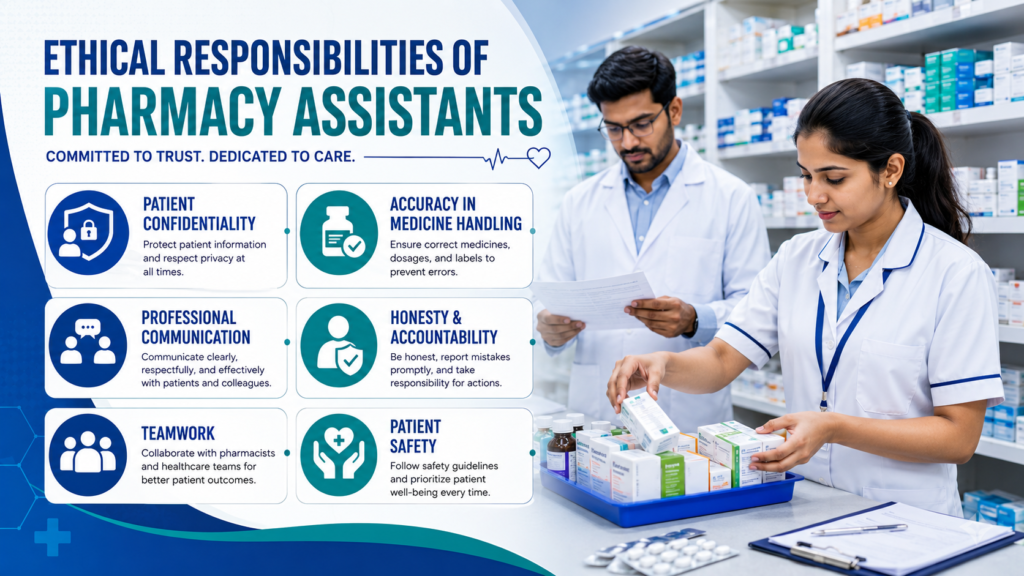
- Following safety procedures.
- Protecting confidential information.
These duties call for honesty, discipline, and meticulousness.
Maintaining Patient Confidentiality
Patients share confidential personal information with healthcare practitioners. Pharmacy assistants can get prescriptions, health records, and other personal information when carrying out their responsibilities.
Maintaining confidentiality means:
- Never disclosing any patient information without consent.
- Handling prescriptions carefully.
- Protecting medical records.
- Following hospital privacy guidelines.
In RIAHS, students are taught how to respect patient confidentiality during their professional studies.
Accuracy in Medicine Handling
Precision is paramount in any pharmacy. Any little mistake can result in unnecessary confusion.
A pharmacy assistant with integrity will always:
- Check medicine labels carefully.
- Arrange medicines systematically.
- Monitor expiry dates.
- Medicines should be stored based on the instructions.
- Report to the supervisor pharmacist in case there are any problems detected.
This behavior when training will make the students reliable professionals in healthcare.
Professional Communication
The pharmacy technicians have interactions with pharmacists, physicians, nurses, and patients on a daily basis. Good communication makes work easier for everyone.
Professional communication includes:
- Speaking politely.
- Listening carefully.
- Accurate information within one’s responsibilities.
- Seeking clarification whenever required.
- Maintaining a positive attitude.
Communication is promoted at Rajamma Institute of Allied Health Sciences (RIAHS) together with technical education for students to be ready for the field of health care.
Working as Part of a Healthcare Team
Pharmacy assistants are important members of the health care team.
Successful teamwork requires:
- Respect for colleagues.
- Clear communication.
- Willingness to learn.
- Cooperation during busy situations.
- Commitment to patient well-being.
RIAH students acquire skills in teamwork through practical learning processes which resemble those in the professional world.
Building Ethical Values Through Practical Training
Ethics cannot be taught simply from the books. Through practical learning, students can learn how professional ethics apply in practice.
When a student enrolls in Rajamma Institute of Allied Health Sciences (RIAHS), he or she gets practical exposure that enables him or her to:
- Develop professional discipline.
- Improve decision-making skills.
- Build confidence.
- Practice responsible medicine handling.
- Understand healthcare standards.
Combination of theory and practice is an effective formula that helps students succeed in their careers.
Why Choose RIAHS for Pharmacy Assistant Education?
Students who opt for Rajamma Institute of Allied Health Sciences (RIAHS) have a learning process oriented towards technical and professional aspects.
Highlights include:
- Experienced faculty guidance.
- Practical-oriented learning.
- On-the-Job Training (OJT).
- Student-focused education.
- Career-oriented healthcare programmes.
- Professionalism and Responsibility.
Through nurturing ethics in addition to skills, students will be ready for modern-day healthcare settings.
Frequently Asked Questions
1. What are the ethical responsibilities of a Pharmacy Assistant?
These include patient confidentiality, proper use of medicines, professional communication, and pharmacy procedures.
2. Why is confidentiality important in pharmacy?
Patient confidentiality creates trust and helps uphold professional healthcare standards.
3. What skills should a Pharmacy Assistant develop?
The students need to develop skills like communication, attention to detail, teamwork, professionalism, and ethical decision making.
4. How does RIAHS prepare Pharmacy Assistant students?
RIAHS provides classroom learning, practical learning, and On-the-Job Training (OJT) to train students to be responsible healthcare professionals.
5. Who is eligible to join the Pharmacy Assistant course at RIAHS?
Students who have passed the 10th standard, 12th standard (pass/fail), or who have any degree can contact RIAHS for admission.