Common Diagnostic Tests Explained
If you’ve ever gone for a health check-up, there’s a good chance you’ve been asked to take a blood test or provide a urine sample. Most people simply wait for the report, but inside a diagnostic laboratory, every sample goes through a careful process before the final results reach the doctor.
That’s why Clinical Pathology is such an important part of healthcare. Laboratory professionals work behind the scenes to ensure every test is performed with precision, helping doctors understand a patient’s health more accurately.
At Rajamma Institute of Allied Health Sciences (RIAHS), a unit of Rajamma Medical Foundation (RMF), students learn not only how these tests are performed but also why accuracy, responsibility, and professional laboratory practices matter in every step.
Understanding the Role of Diagnostic Tests
Diagnostic tests help healthcare professionals gather important information about the body. They often confirm a medical condition, monitor recovery, or provide a clearer picture of a patient’s overall health.
Some of the most common reasons for laboratory investigations include:
- Routine medical check-ups
- Identifying infections
- Monitoring long-term health conditions
- Evaluating organ function
- Supporting preventive healthcare
Without reliable laboratory reports, many medical decisions would become much more difficult.
Complete Blood Count (CBC)
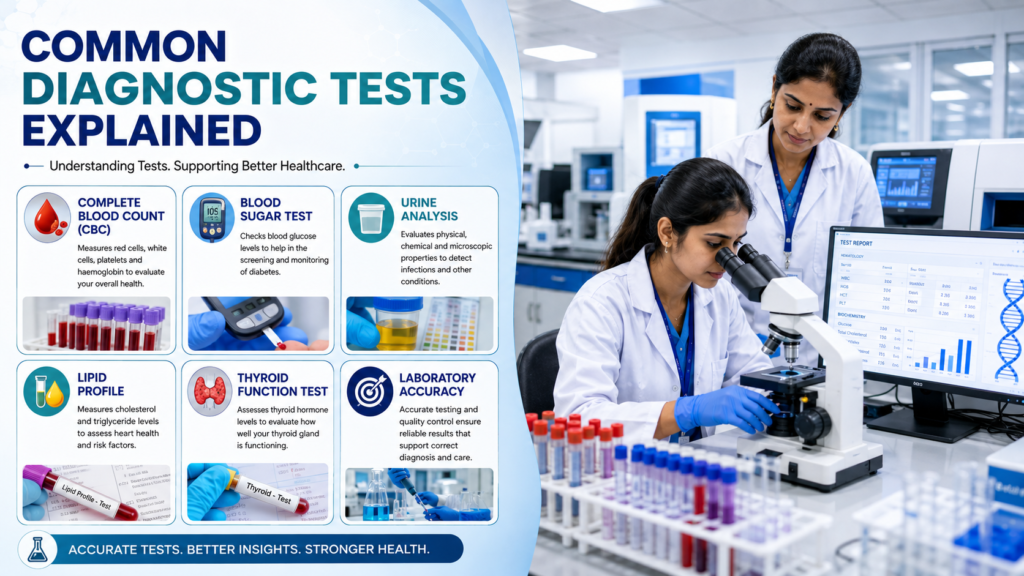
The Complete Blood Count (CBC) is one of the most commonly performed laboratory investigations.
It provides information about different components of blood, including:
- Red blood cells
- White blood cells
- Platelets
- Haemoglobin levels
Clinical Pathology students learn why proper sample collection and careful laboratory procedures are essential for accurate results.
Blood Sugar Test
Blood sugar testing is widely used during routine health examinations.
Students gain practical knowledge about:
- Safe sample handling
- Laboratory workflow
- Recording procedures
- Equipment preparation
- Professional laboratory practices
Understanding these procedures helps students appreciate the importance of maintaining consistency throughout the testing process.
Urine Analysis
Urine analysis may appear simple, but it provides valuable information about a person’s health.
During practical laboratory sessions, students observe:
- Sample preparation
- Physical examination
- Laboratory hygiene
- Documentation methods
- Quality control practices
Learning these techniques helps students understand the role of laboratory investigations in everyday healthcare.
Lipid Profile
A Lipid Profile measures different types of fats present in the blood and is commonly included in routine health assessments.
Students become familiar with:
- Laboratory protocols
- Sample processing
- Equipment usage
- Safety procedures
- Professional reporting practices
Every step requires careful attention to detail and adherence to laboratory standards.
Thyroid Function Test
The thyroid gland plays an important role in regulating many body functions. Thyroid Function Tests help healthcare professionals evaluate how well the gland is working.
Students learn about:
- Laboratory testing procedures
- Quality assurance
- Accurate documentation
- Sample management
- Professional laboratory ethics
These experiences strengthen their understanding of diagnostic laboratory operations.
Practical Learning at RIAHS
Learning Clinical Pathology becomes much more effective when students experience laboratory work firsthand.
At Rajamma Institute of Allied Health Sciences (RIAHS), students benefit from:
- Practical laboratory sessions
- Experienced faculty guidance
- On-the-Job Training (OJT)
- Modern laboratory facilities
- Student-focused learning
- Industry-oriented education
The combination of classroom teaching and practical exposure helps students develop confidence while understanding professional laboratory responsibilities.
Frequently Asked Questions
1. What are diagnostic tests?
Diagnostic tests are laboratory investigations that help doctors evaluate health conditions and support medical diagnosis.
2. What is the purpose of a Complete Blood Count (CBC)?
A CBC measures different components of blood and provides useful information about a person’s overall health.
3. Why is laboratory accuracy important?
Accurate laboratory procedures help ensure reliable reports that support better medical decision-making.
4. Does RIAHS provide practical laboratory experience?
Yes. RIAHS combines classroom education with practical laboratory sessions and On-the-Job Training (OJT) to help students develop professional skills.
5. Who can apply for the Clinical Pathology programme?
Students who have completed 10th, 12th (pass or fail), or any degree can contact RIAHS for admission guidance.