How Artificial Intelligence is Changing Healthcare
Artificial Intelligence is no longer something we only hear about in technology discussions. It has become part of healthcare helping hospitals improve efficiency support medical professionals and deliver better patient care. While doctors, nurses and healthcare workers continue to make clinical decisions AI provides valuable information that helps them work more confidently and accurately.
From diagnosing diseases to organising medical records Artificial Intelligence is changing the way healthcare is delivered. Students entering healthcare today will work in an environment where technology and patient care go hand in hand.
At Rajamma Institute of Allied Health Sciences (RIAHS) a unit of Rajamma Medical Foundation (RMF) students learn healthcare skills while gaining awareness of the modern technologies shaping todays medical industry.
Artificial Intelligence Is Supporting Modern Healthcare
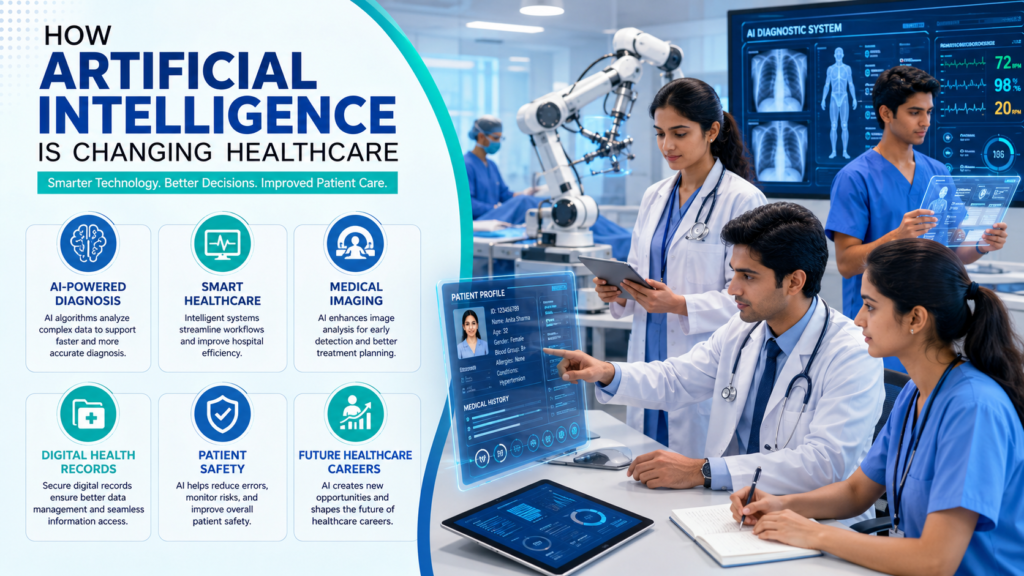
Healthcare organisations are using AI to improve aspects of patient care and hospital management.
AI is helping with:
- Medical image analysis
- Disease detection
- Digital health records
- Laboratory automation
- Clinical decision support
- Smart hospital management
These technologies allow healthcare professionals to work efficiently while maintaining quality patient care.
Better Care Through Smarter Technology
Artificial Intelligence can analyse information much faster than traditional systems helping healthcare teams make timely decisions.
Some advantages include:
- Diagnosis
- Improved treatment planning
- Better patient monitoring
- Reduced administrative work
- Improved accuracy
- Efficient healthcare services
Technology supports healthcare professionals allowing them to spend more time caring for patients.
AI Is Creating Opportunities
As hospitals continue adopting advanced healthcare technologies, professionals who understand both patient care and digital healthcare systems are becoming increasingly valuable.
Students learn about:
- AI-assisted diagnostics
- Smart healthcare systems
- Electronic medical records
- Healthcare data management
- Laboratory technology
- Emerging healthcare innovations
Understanding these developments prepares students for future healthcare careers.
Learning Modern Healthcare at RIAHS
Healthcare education continues to evolve alongside technology. Students benefit from learning healthcare skills while understanding how innovation improves patient care.
At RIAHS students receive:
- Practical healthcare training
- Faculty
- Modern learning facilities
- Clinical exposure
- Student-focused guidance
- Industry-oriented education
This learning approach prepares students for todays technology-driven healthcare environment.
Why Choose RIAHS?
At Rajamma Institute of Allied Health Sciences (RIAHS) students receive career-focused healthcare education that combines learning with an understanding of modern medical technologies.
Students benefit from:
- Experienced faculty
- Practical-oriented learning
- Modern healthcare facilities
- Exposure
- Career-focused programmes
- Healthcare industry readiness
Frequently Asked Questions
1. What is Artificial Intelligence in healthcare?
Artificial Intelligence uses computer systems to help healthcare professionals analyse medical information, support diagnosis and improve patient care.
2. Can AI replace doctors and healthcare professionals?
No. AI is designed to assist healthcare professionals by providing information while all important medical decisions continue to be made by qualified professionals.
3. Where is Artificial Intelligence used in healthcare?
AI is used in laboratories, medical imaging, digital health records, hospital management, disease detection and patient monitoring.
4. Does RIAHS prepare students for technology-driven healthcare?
Yes. RIAHS combines healthcare education with exposure, to modern healthcare technologies and current industry practices.
5. Why choose RIAHS?
RIAHS offers faculty, practical learning, modern facilities and career-focused healthcare education that prepares students for the future of healthcare.