
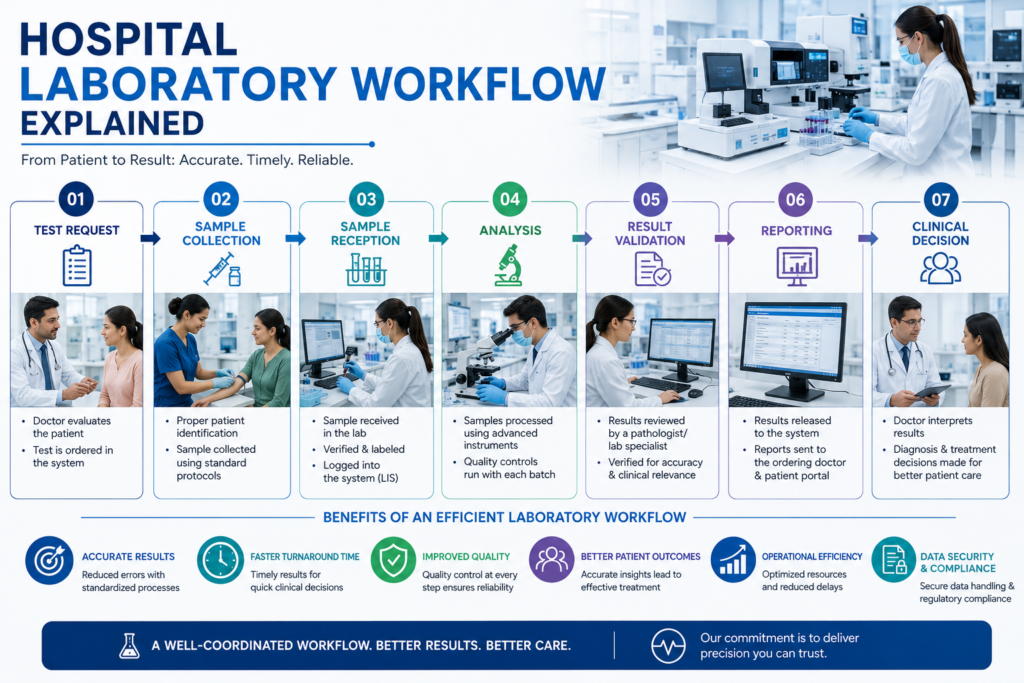
Hospital Laboratory Workflow Explained: From Sample Collection to Test Results
A hospital laboratory plays a vital role in patient care. Doctors and healthcare professionals depend on laboratory tests to diagnose diseases, monitor treatment, assess health conditions, and make informed clinical decisions.
A well-organized laboratory workflow ensures that patient samples are collected, processed, tested, and reported accurately and efficiently.
What Is a Hospital Laboratory Workflow?
Hospital laboratory workflow refers to the complete process followed from the time a laboratory test is requested until the final result is reported to the healthcare team.
The workflow generally consists of three major stages:
- Pre-analytical phase
- Analytical phase
- Post-analytical phase
Each stage is important for maintaining the accuracy and reliability of laboratory results.
1. Test Request and Patient Identification
The process begins when a doctor or authorized healthcare professional requests a laboratory test.
The laboratory request contains important information such as:
- Patient identification details
- Required laboratory tests
- Clinical information when necessary
- Sample type
- Priority of the test
Correct patient identification is essential because errors at this stage can affect the entire testing process.
2. Sample Collection
After the test is requested, the appropriate specimen is collected from the patient.
Depending on the test, samples may include:
- Blood
- Urine
- Sputum
- Swabs
- Body fluids
- Tissue specimens
Healthcare and laboratory personnel follow appropriate collection procedures to ensure that the correct specimen is obtained.
3. Sample Labelling and Transportation
After collection, the specimen must be properly labelled and transported to the laboratory.
Accurate labelling helps maintain patient and sample identification throughout the workflow. Samples should also be transported under appropriate conditions, particularly when temperature, time, or other factors can affect the specimen.
4. Sample Reception and Registration
When the specimen reaches the laboratory, laboratory staff verify the sample and test request.
The sample may then be registered in the laboratory information system. The laboratory checks whether the specimen is suitable for the requested examination.
If a sample is incorrectly labelled, damaged, insufficient, or otherwise unsuitable, it may require rejection or recollection according to laboratory procedures.
5. Sample Preparation
Before testing, specimens may need preparation depending on the type of examination.
For example, laboratory staff may need to:
- Separate serum or plasma
- Centrifuge samples
- Prepare slides
- Aliquot specimens
- Apply appropriate processing procedures
Proper preparation helps ensure that the specimen is suitable for analysis.
6. Laboratory Testing
This is the analytical stage of the workflow.
Different laboratory departments perform different types of investigations, including:
Hematology
Hematology laboratories examine blood cells and related parameters. Complete blood counts and other hematological investigations are common examples.
Biochemistry
Clinical biochemistry tests measure substances such as glucose, enzymes, electrolytes, proteins, and other biochemical markers.
Microbiology
Microbiology laboratories examine specimens for microorganisms and may perform culture, identification, and antimicrobial susceptibility testing.
Immunology and Serology
These departments perform tests involving antibodies, antigens, hormones, and other immune-related markers.
Histopathology
Histopathology involves the examination of tissue specimens to help identify abnormalities and diseases.
7. Quality Control
Quality control is an essential part of laboratory testing.
Laboratories use quality-control procedures to monitor the performance of instruments, reagents, and testing methods. Quality checks help identify problems before unreliable results are reported.
Laboratory professionals also follow established procedures, maintenance schedules, and quality-management practices.
8. Result Verification
Once testing is completed, the generated results are reviewed.
Depending on the test and laboratory procedure, results may be automatically transmitted from laboratory instruments to the laboratory information system or reviewed by qualified laboratory professionals.
Abnormal or unusual findings may require additional verification before reporting.
9. Reporting of Results
After verification, the final laboratory report is released to the authorized healthcare team or patient according to the hospital’s procedures.
Reports may be delivered through:
- Laboratory information systems
- Hospital electronic medical records
- Printed reports
- Other approved reporting systems
Clear and accurate reporting is important because laboratory results can directly influence clinical decisions.
10. Communication of Critical Results
Some laboratory findings may require urgent communication because they could indicate a potentially serious clinical situation.
Hospitals generally have procedures for identifying and communicating critical results to the appropriate healthcare professional.
Prompt communication can help support timely patient management.
Importance of an Efficient Laboratory Workflow
An efficient laboratory workflow can provide several benefits:
- Improves sample traceability
- Reduces avoidable errors
- Supports accurate testing
- Improves turnaround time
- Helps manage large numbers of samples
- Strengthens quality control
- Supports effective communication
- Contributes to better patient care
Role of Technology in Laboratory Workflow
Modern hospitals increasingly use technology to improve laboratory operations. Automated analyzers, barcode systems, laboratory information systems, sample-tracking systems, and other digital tools can help reduce repetitive manual tasks and improve workflow efficiency.
Automation can also help laboratories process high volumes of specimens while maintaining standardized procedures.
Role of Medical Laboratory Professionals
Technology is an important part of modern laboratories, but trained laboratory professionals remain essential.
Medical laboratory professionals are involved in specimen handling, testing procedures, quality control, equipment operation, result verification, documentation, and maintaining laboratory safety standards.
Their skills and attention to detail contribute significantly to the reliability of laboratory services.
Conclusion
Hospital laboratory workflow is a structured process that begins with a test request and patient identification and continues through sample collection, transportation, processing, analysis, quality control, result verification, and reporting.
Every stage must be performed carefully because laboratory results play an important role in diagnosis and patient management. Understanding this workflow is especially valuable for students and aspiring professionals interested in Medical Laboratory Technology and allied healthcare careers.
Frequently Asked Questions
1. What are the three main stages of laboratory workflow?
The three main stages are the pre-analytical, analytical, and post-analytical phases.
2. Why is sample identification important?
Correct identification helps ensure that the laboratory result is associated with the correct patient and reduces the risk of identification errors.
3. What happens during the analytical phase?
During the analytical phase, the laboratory performs the requested tests using appropriate instruments, methods, and procedures.
4. What is the purpose of laboratory quality control?
Quality control helps monitor testing performance and identify problems that could affect the reliability of laboratory results.
5. How does technology improve laboratory workflow?
Automation, barcode systems, laboratory information systems, and automated analyzers can improve efficiency, traceability, and consistency.
6. What is the role of medical laboratory professionals?
They support the complete testing process, including specimen handling, analysis, quality control, equipment operation, documentation, and appropriate result verification.