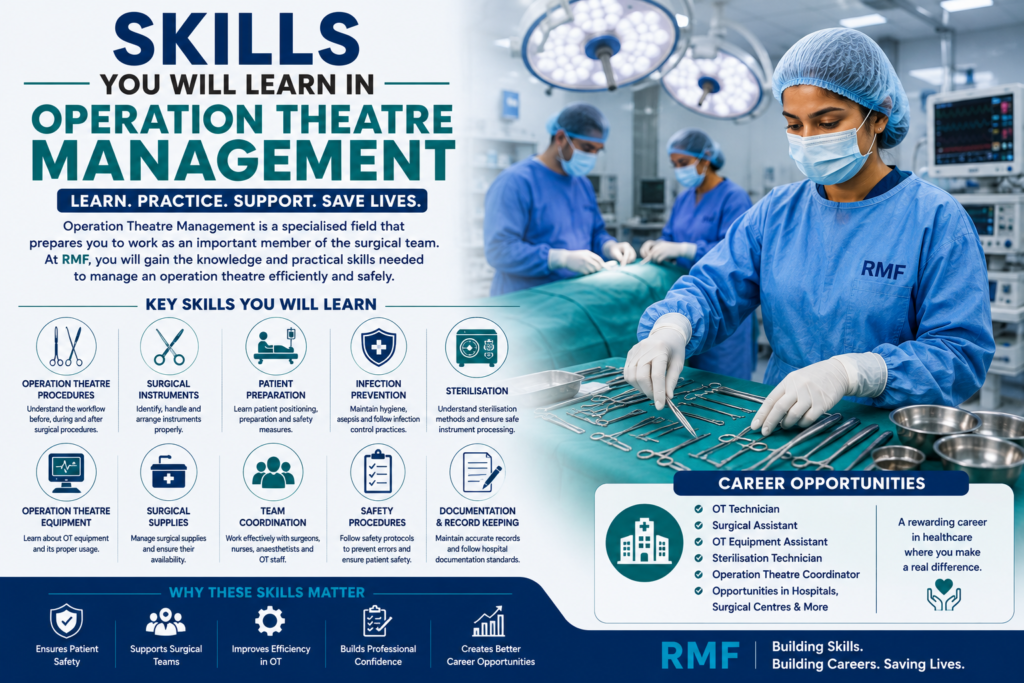
Skills You Will Learn in an Operation Theatre Management
Operation Theatre Management is a practical healthcare field that introduces students to the activities and responsibilities involved in an operation theatre.
An operation theatre requires proper preparation, equipment, cleanliness, patient safety and teamwork.
Students can develop technical knowledge and professional skills that can help them understand how operation theatre teams work.
Operation Theatre Procedures
Students can learn about the activities that take place before, during and after surgical procedures.
Understanding operation theatre procedures can help students become familiar with the workflow of a surgical environment.
Surgical Instruments
Surgical instruments are important in operation theatre work.
Students can learn how to identify instruments and understand their purpose and handling.
This knowledge can help students become more comfortable with the equipment used during surgical procedures.
Patient Preparation
Patients need appropriate preparation before surgery.
Students can learn about preparation, communication, coordination and patient safety.
Attention to detail is important when supporting patient-care activities.
Sterilisation and Infection Prevention
Maintaining cleanliness is essential in an operation theatre.
Students can learn about sterilisation, disinfection, protective equipment and safe instrument handling.
These practices help students understand the importance of infection prevention.
Operation Theatre Equipment
Operation theatres use different equipment to support surgical procedures.
Students can become familiar with equipment and understand its purpose and role within the surgical environment.
Safety Procedures
Students can learn about safety procedures and the importance of following hospital protocols.
Safety awareness can help students develop responsible working habits.
Teamwork and Communication
Operation theatre work involves different healthcare professionals.
Students can learn to communicate clearly, follow instructions, share information and work responsibly as part of a healthcare team.
Time Management
Operation theatre activities can require careful planning and organisation.
Students can develop time-management skills by learning how to organise tasks, prepare supplies and follow schedules.
Professional Responsibility
Students should also develop professional qualities such as:
- Discipline
- Responsibility
- Punctuality
- Communication
- Respect
- Safety awareness
These qualities can help students prepare for professional healthcare environments.
Practical Training
Practical exposure can help students understand how an operation theatre functions.
Students can become familiar with:
- Operation theatre preparation
- Surgical instruments
- Equipment
- Sterilisation
- Safety practices
- Surgical supplies
- Team coordination
- Hospital protocols
Learning at RMF
At RMF, students can develop healthcare knowledge and practical skills related to operation theatre environments.
The Diploma in Operation Theatre Management can help students understand surgical procedures, instruments, equipment, patient preparation, sterilisation, safety and teamwork.
Career Opportunities
After completing the required education and applicable requirements, students can explore suitable opportunities in hospitals, surgical centres and other healthcare institutions.
The exact role depends on the qualification, employer and applicable requirements.
Operation Theatre Management requires technical knowledge, practical skills and professional responsibility.
Students can develop skills related to surgical instruments, patient preparation, sterilisation, equipment, safety, teamwork and hospital procedures.
They can also build communication, discipline, time-management and attention-to-detail skills.
For students interested in practical hospital careers and surgical environments, these skills can provide a useful foundation for their future healthcare journey.
Frequently Asked Questions
1. What skills can students learn in Operation Theatre Management?
Students can learn about surgical instruments, patient preparation, sterilisation, equipment, safety, teamwork and operation theatre procedures.
2. Is practical training important?
Yes. Practical exposure can help students understand operation theatre environments and healthcare procedures.
3. Why is teamwork important?
Operation theatre work involves multiple healthcare professionals, so teamwork helps coordinate responsibilities.
4. What professional skills should students develop?
Communication, discipline, responsibility, attention to detail, time management and safety awareness are important.
5. Where can students explore opportunities?
Depending on their qualification and applicable requirements, students can explore suitable opportunities in hospitals, surgical centres and other healthcare institutions.