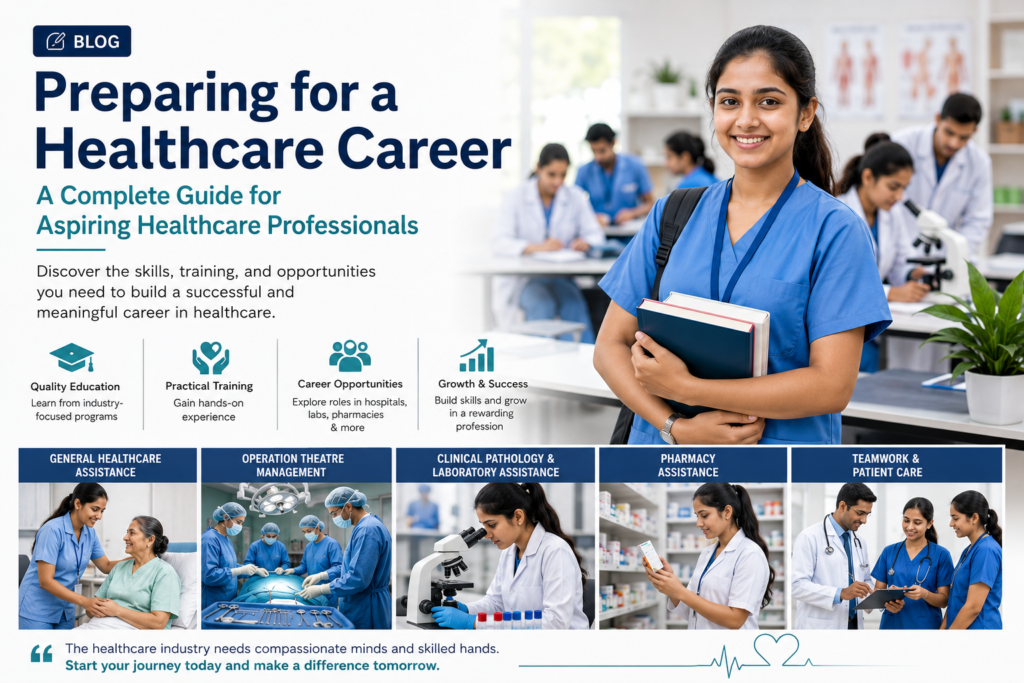
Preparing for a Healthcare Career: A Guide for Future Healthcare Professionals
A career in healthcare is more than just choosing a profession—it is an opportunity to make a meaningful difference in people’s lives. From patient care and clinical support to diagnostic services and operation theatre assistance, the healthcare industry offers a wide range of career opportunities.
For students planning to enter this growing field, proper preparation is essential. Building the right knowledge, practical skills, confidence, and professional attitude can help create a strong foundation for a successful healthcare career.
Why Choose a Career in Healthcare?
Healthcare is an important and continuously evolving sector. Hospitals, clinics, diagnostic centres, rehabilitation facilities, and other healthcare institutions require trained professionals to support quality patient care.
A healthcare career can offer:
- Meaningful work that contributes to patient care
- Opportunities to develop professional and practical skills
- A variety of specialised career paths
- Experience working in professional healthcare environments
- Opportunities for continuous learning and growth
- The satisfaction of being part of an important healthcare team
Whether you are interested in nursing, allied healthcare, operation theatre services, pharmacy support, or general healthcare assistance, choosing the right course is the first step towards your professional journey.
1. Understand Your Interests and Strengths
Before choosing a healthcare course, take time to understand what interests you most.
Ask yourself:
- Do I enjoy helping and interacting with people?
- Am I interested in medical science and healthcare?
- Would I like to work in a hospital or clinical environment?
- Am I interested in surgery and operation theatre procedures?
- Do I enjoy working with medical equipment and technology?
- Can I remain calm, responsible, and focused in important situations?
Your interests and strengths can help you choose a healthcare career path that is suitable for you.
2. Choose the Right Healthcare Course
Healthcare offers many different career options. It is important to select a course that matches your interests and future goals.
Some areas of healthcare education include:
Operation Theatre Management
Students interested in surgical environments can develop knowledge and practical skills related to operation theatre procedures, equipment, sterilisation practices, and surgical team support.
General Healthcare Assistance
This field focuses on supporting healthcare professionals and assisting with essential patient-care activities in clinical environments.
Pharmacy Assistance
Students can learn about pharmacy support, medication handling procedures, inventory support, and working within a professional pharmacy environment.
Other Allied Healthcare Fields
Allied healthcare offers specialised opportunities for students who want to support doctors, nurses, and other healthcare professionals in different clinical departments.
The right course can help you develop a clear direction for your career.
3. Focus on Practical Skills
Healthcare is a practical profession. Classroom learning provides important theoretical knowledge, but hands-on training helps students understand how healthcare environments work.
Practical training can help students develop:
- Professional communication skills
- Confidence in clinical environments
- Knowledge of healthcare equipment
- Understanding of hygiene and safety practices
- Teamwork and coordination skills
- Time management
- Professional discipline
- Awareness of patient-care procedures
Students should look for training programmes that provide opportunities to understand real healthcare and clinical environments.
4. Develop Strong Communication Skills
Communication is an essential skill for healthcare professionals.
Healthcare workers may need to communicate with patients, doctors, nurses, colleagues, and family members. Clear and respectful communication can help create a better healthcare experience.
Students should work on:
- Speaking clearly and professionally
- Listening carefully
- Showing respect and empathy
- Understanding instructions correctly
- Working effectively with a team
Good communication can make a significant difference in professional development.
5. Learn the Importance of Teamwork
Healthcare is built on teamwork.
Doctors, nurses, technicians, assistants, therapists, and other healthcare professionals often work together to provide quality patient care. Every role has an important responsibility.
Students preparing for a healthcare career should learn how to:
- Respect other healthcare professionals
- Follow professional instructions
- Coordinate with team members
- Take responsibility for assigned duties
- Maintain a positive and professional attitude
The ability to work as part of a team is an important skill in every healthcare environment.
6. Build Professional Discipline
Healthcare professionals work in environments where responsibility, punctuality, hygiene, and discipline are extremely important.
Developing good habits during your training can prepare you for your future career.
Important professional qualities include:
- Punctuality
- Cleanliness and personal hygiene
- Responsibility
- Attention to detail
- Respect for professional protocols
- Willingness to learn
- Maintaining confidentiality
- A positive attitude
These qualities can help students become more confident and prepared professionals.
7. Gain Clinical Exposure
Clinical exposure can help students understand how healthcare systems operate in real-world situations.
Observing and learning in a professional environment can provide valuable insights into:
- Hospital departments
- Healthcare workflows
- Patient-care environments
- Medical equipment
- Professional responsibilities
- Team coordination
Practical exposure helps bridge the gap between classroom learning and professional work.
8. Stay Updated and Keep Learning
Healthcare is a field that continues to develop with new technologies, equipment, practices, and procedures.
A successful healthcare professional should have a willingness to learn throughout their career.
Students can continue developing themselves by:
- Improving practical skills
- Learning about healthcare technology
- Attending professional training
- Developing communication skills
- Staying informed about developments in their field
Continuous learning can help professionals adapt and grow.
Start Your Healthcare Journey with the Right Training
At Rajamma Institute of Allied Health Sciences, we aim to help students build the knowledge, practical skills, and professional confidence required to begin their journey in the healthcare sector.
Our focus is on supporting students through healthcare education, practical learning, clinical exposure, and skill development.
If you are planning to build a future in healthcare, choosing the right training and developing the right skills today can help prepare you for tomorrow’s opportunities.
Take the First Step Towards Your Healthcare Career
Your healthcare career begins with preparation, learning, and the confidence to take the next step.
Rajamma Institute of Allied Health Sciences
No. 4, Audiappa Mudali Street,
Opposite Lady MCTM School,
Purasawalkam, Chennai – 600084
Call: 8608589111 / 8608589000
Email: rajammamedicalfoundation@gmail.com