What is Clinical Pathology?
When a patient visits a hospital or clinic, doctors may need additional information before making decisions about their care. Laboratory tests can provide information about what is happening inside the body.
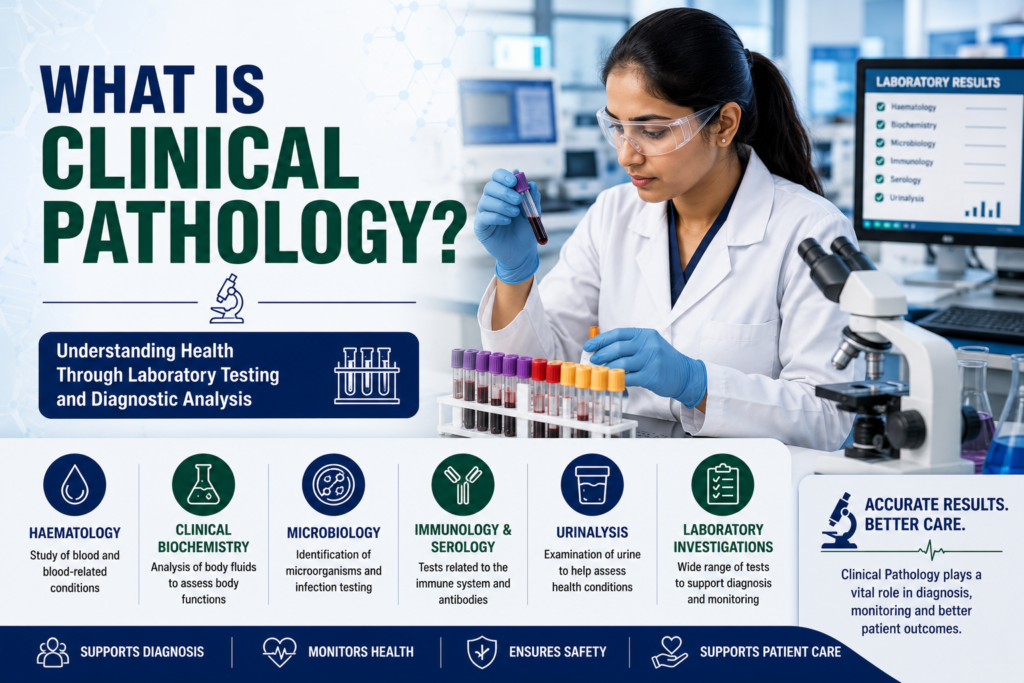
Clinical Pathology is a branch of laboratory medicine that focuses on examining samples and using laboratory tests to support the diagnosis, monitoring and management of health conditions.
Blood, urine and other biological samples can be examined using laboratory methods. The results can then be used by healthcare professionals as part of the patient’s overall clinical assessment.
What Does Clinical Pathology Involve?
Clinical Pathology covers different areas of laboratory testing.
Depending on the laboratory and the type of testing being performed, areas can include:
- Blood testing
- Urine testing
- Clinical chemistry
- Haematology
- Microbiology
- Immunology
- Serology
- Other laboratory investigations
Each area provides different types of information about a patient’s health.
Why Is Clinical Pathology Important?
Laboratory testing is an important part of modern healthcare.
1. Supports Diagnosis
Doctors may use laboratory results along with symptoms, medical history, physical examination and other investigations when assessing a patient.
Laboratory findings can provide information that supports the diagnostic process.
2. Helps Monitor Health Conditions
Some patients need repeated tests to monitor their condition or response to treatment.
Laboratory results can help qualified healthcare professionals follow changes over time.
3. Supports Patient Care
Accurate laboratory information can contribute to better-informed healthcare decisions.
Clinical Pathology therefore plays a supporting role in hospitals, clinics and diagnostic laboratories.
4. Helps Detect Abnormalities
Laboratory testing can identify changes in blood, urine or other samples that may require medical evaluation.
The meaning of a test result depends on the test, patient and clinical situation.
Common Areas of Clinical Pathology
Haematology
Haematology focuses on blood and blood-related conditions.
Laboratory professionals may examine blood cells and other blood-related measurements as part of laboratory investigations.
Clinical Biochemistry
Clinical biochemistry involves analysing substances in body fluids such as blood and urine.
Tests can provide information about different aspects of body function.
Microbiology
Microbiology involves the study and identification of microorganisms.
Laboratory testing in this area can help healthcare professionals investigate infections.
Immunology and Serology
These areas involve laboratory investigations related to the immune system and substances found in blood, such as antibodies and antigens.
Urinalysis
Urine testing can provide information about different aspects of a person’s health and may be used as part of the assessment of certain conditions.
How Does a Clinical Pathology Test Work?
Laboratory testing generally follows several important steps.
1. Sample Collection
A suitable patient sample is collected according to the requirements of the test.
2. Sample Identification
Correct identification and handling of the sample are essential to reduce the risk of errors.
3. Laboratory Processing
The sample is prepared and processed using appropriate laboratory procedures and equipment.
4. Analysis
The required laboratory test is performed using appropriate methods.
5. Reporting
Results are recorded and reported through the appropriate laboratory process.
The results are then considered by healthcare professionals along with other patient information.
Why Accuracy Matters in Clinical Pathology
Laboratory results can contribute to healthcare decisions, so accuracy is essential.
Clinical laboratory professionals need to pay attention to:
- Sample collection
- Proper sample identification
- Safe sample handling
- Appropriate laboratory procedures
- Equipment use
- Quality control
- Accurate documentation
- Reporting procedures
Following laboratory protocols helps maintain the quality and reliability of testing.
Role of Laboratory Professionals
Clinical Pathology depends on trained laboratory professionals who work behind the scenes of patient care.
Depending on their education and role, laboratory professionals may be involved in:
- Receiving and processing samples
- Performing laboratory tests
- Operating laboratory equipment
- Following quality-control procedures
- Maintaining laboratory safety
- Recording laboratory information
- Communicating laboratory information through established procedures
Different responsibilities are assigned according to professional qualifications and workplace requirements.
Clinical Pathology and Healthcare Technology
Modern clinical laboratories use a combination of knowledge, laboratory equipment and technology.
Automated analysers and digital laboratory systems can support laboratory workflows. Trained professionals remain important for proper sample handling, quality procedures, equipment operation and interpretation within their professional responsibilities.
Technology continues to change laboratory work, making technical knowledge and continuous learning increasingly valuable.
Skills Needed in Clinical Laboratory Work
Students interested in Clinical Pathology and laboratory careers can develop several useful skills.
Attention to Detail
Small errors in identification, handling or testing can affect laboratory work, making careful attention important.
Technical Skills
Students need to become familiar with laboratory equipment, procedures and safety practices.
Analytical Thinking
Understanding laboratory procedures and results requires analytical thinking.
Safety Awareness
Laboratories handle samples and chemicals, so following appropriate safety procedures is essential.
Teamwork
Laboratory professionals work alongside doctors, nurses and other healthcare workers as part of the healthcare team.
Clinical Pathology as a Career Area
Students interested in laboratory-based healthcare may explore education in areas related to medical laboratory science and clinical laboratory technology.
A career in this field can suit students who enjoy:
- Science
- Laboratory work
- Medical technology
- Diagnostic testing
- Detailed practical work
- Healthcare environments
The qualifications required for specific laboratory roles depend on the job and applicable professional or institutional requirements.
Clinical Pathology Education at RMF
Rajamma Medical Foundation (RMF) provides healthcare education and training for students interested in healthcare careers.
Students interested in laboratory-based healthcare can explore RMF programmes and training opportunities.
Before applying, students should check the RMF information regarding:
- Course eligibility
- Programme duration
- Admission requirements
- Training structure
- Current course availability
Why Students Should Learn About Clinical Pathology
Clinical Pathology connects science, technology and patient care.
Students who choose laboratory-based healthcare education can develop knowledge while learning how laboratory services contribute to the wider healthcare system.
Hands-on training can also help students become familiar with laboratory environments, equipment, safety practices and professional responsibilities.
Conclusion
Clinical Pathology is a part of modern laboratory medicine. By examining patient samples through laboratory tests, Clinical Pathology provides information that can support diagnosis, monitoring and patient care.
For students interested in science, medical technology and laboratory work, Clinical Pathology can be an interesting healthcare career area to explore.
Proper education, practical training, attention to detail and a commitment to laboratory safety can help students build a foundation for their future healthcare careers.
Frequently Asked Questions
1. What is Clinical Pathology?
Clinical Pathology is a branch of laboratory medicine that uses laboratory testing of samples to provide information that supports healthcare.
2. What samples are used in Clinical Pathology?
Depending on the test, laboratories may examine samples such as blood, urine and other biological specimens.
3. What are the main areas of Clinical Pathology?
Areas can include haematology, clinical biochemistry, microbiology, immunology, serology and urinalysis.
4. Why is Clinical Pathology important?
Clinical Pathology provides laboratory information that can support diagnosis, monitoring and healthcare decisions.
5. Is Clinical Pathology suitable for students interested in laboratory work?
It can be suitable for students interested in science, laboratory procedures, medical technology and diagnostic testing. Students should consider the qualifications and career requirements for the role they want to pursue.