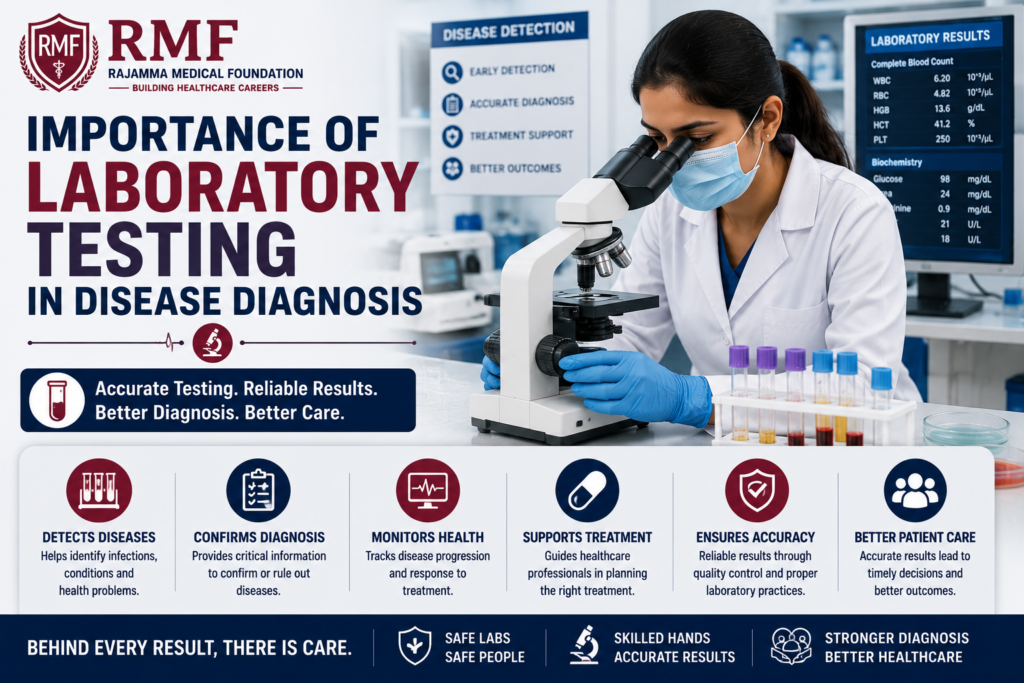
Importance of Laboratory Testing in Disease Diagnosis
When a patient visits a hospital or clinic, healthcare professionals may need more information to understand what is happening inside the body.
Laboratory testing provides important information by examining patient samples such as blood, urine and other biological specimens. These results can support healthcare professionals when assessing a patient’s condition.
For students interested in laboratory and healthcare careers, understanding the importance of diagnostic testing can help them appreciate the role of clinical laboratories in modern healthcare.
What Is Laboratory Testing?
Laboratory testing involves examining patient samples using appropriate methods and equipment.
Depending on the patient’s situation and the tests requested, laboratories may examine:
- Blood
- Urine
- Body fluids
- Tissue samples
- Other biological specimens
Different tests provide different types of information. The healthcare professional responsible for the patient’s care decides which tests are appropriate based on the clinical situation.
Why Is Laboratory Testing Important?
1. Supports Disease Detection
Laboratory tests can provide information that helps healthcare professionals identify or investigate possible diseases and health conditions.
Test results are considered together with symptoms, medical history, physical examination and other clinical information.
2. Helps Confirm or Assess a Diagnosis
A laboratory result can provide additional evidence when a healthcare professional is assessing a suspected condition.
Laboratory testing is therefore an important part of the diagnostic process.
3. Helps Monitor Health Conditions
Some laboratory tests can be repeated over time to help healthcare professionals monitor a patient’s condition.
Changes in test results may provide useful information about how a condition is developing or responding to care.
4. Supports Treatment Decisions
Laboratory results can provide information that healthcare professionals may consider when planning or adjusting treatment.
The appropriate interpretation of results should always be made by qualified healthcare professionals in the context of the patient.
5. Helps Identify Health Problems Early
Some laboratory tests can identify changes before a person experiences obvious symptoms.
Depending on the test and clinical situation, this may support earlier assessment and management of certain health conditions.
Common Types of Laboratory Testing
Clinical laboratories perform many different types of tests.
Blood Testing
Blood samples can be used for a wide range of investigations, including tests related to blood cells, glucose, organs, hormones and other health indicators.
Urine Testing
Urine tests can provide information relevant to certain infections, kidney-related conditions and other health concerns.
Microbiology Testing
Microbiology laboratories examine samples for microorganisms and can support the investigation of infections.
Biochemistry Testing
Biochemistry tests examine substances in body fluids and can provide information about different aspects of health and organ function.
Haematology Testing
Haematology focuses on blood and blood-related conditions and includes the study of blood cells and other components.
Histopathology
Histopathology involves examining tissue samples to help investigate diseases and abnormalities.
The tests available depend on the laboratory and its services.
The Laboratory Testing Process
Laboratory testing involves several steps.
Sample Collection
The appropriate patient sample is collected according to established procedures.
Sample Identification
Correct identification and labelling are essential to ensure that the sample is associated with the correct patient.
Sample Preparation
Depending on the test, samples may need to be prepared before analysis.
Testing and Analysis
Laboratory professionals use appropriate methods and equipment to analyse samples.
Quality Checks
Laboratories use quality-control procedures to help ensure that testing is performed consistently and reliably.
Reporting Results
Results are documented and reported through the appropriate laboratory and healthcare systems.
The healthcare professional caring for the patient then interprets the results along with other clinical information.
Why Accurate Sample Handling Matters
A laboratory result is only useful when the sample has been handled correctly.
Errors can occur if samples are:
- Incorrectly labelled
- Collected improperly
- Stored incorrectly
- Transported under unsuitable conditions
- Contaminated
- Processed incorrectly
This is why laboratory staff need to follow established procedures carefully.
Attention to detail is an essential quality in laboratory work.
Role of Laboratory Professionals
Laboratory testing depends on trained professionals who perform and support laboratory procedures.
Depending on their qualifications and roles, laboratory professionals may be involved in:
- Receiving and preparing samples
- Performing laboratory procedures
- Operating appropriate equipment
- Maintaining laboratory records
- Following safety procedures
- Performing quality-control activities
- Communicating relevant laboratory information
- Maintaining laboratory hygiene
Each professional must work within their education, training and assigned responsibilities.
Importance of Laboratory Safety
Clinical laboratories may involve biological samples, chemicals, equipment and other hazards.
Laboratory professionals should therefore follow appropriate safety practices, including:
- Using personal protective equipment
- Following infection-control procedures
- Handling samples carefully
- Disposing of waste appropriately
- Maintaining clean work areas
- Following laboratory protocols
- Reporting accidents or hazards
Safety protects laboratory workers and contributes to a reliable laboratory environment.
Laboratory Testing and Patient Care
Laboratory results do not exist separately from the rest of a patient’s healthcare.
Doctors and other qualified healthcare professionals consider laboratory findings alongside:
- Patient symptoms
- Medical history
- Physical examination
- Imaging results
- Other diagnostic information
This combined information helps healthcare professionals make informed decisions about patient care.
Why Technology Matters in Laboratory Testing
Modern laboratories use a range of technologies to support diagnostic testing.
Automated systems and laboratory equipment can help process samples efficiently and support consistent testing.
However, technology does not remove the need for trained laboratory professionals.
People are still needed to:
- Prepare samples correctly
- Operate equipment appropriately
- Monitor procedures
- Recognise problems
- Follow quality-control processes
- Maintain records
- Work safely
Technical knowledge and human attention remain important parts of laboratory services.
Skills Needed in Laboratory Careers
Students interested in laboratory careers can develop several important skills.
Attention to Detail
Laboratory work requires careful handling of samples, equipment and information.
Technical Skills
Understanding laboratory equipment and procedures is important for working effectively.
Safety Awareness
Professionals need to understand laboratory safety and infection-control practices.
Organisation
Laboratories handle many samples and procedures, making organised working essential.
Communication
Laboratory professionals work with other healthcare workers and need to communicate information clearly.
Teamwork
Clinical laboratory services depend on collaboration between different professionals.
Why Practical Training Matters
Laboratory education should combine theoretical knowledge with practical learning.
Hands-on training can help students become familiar with:
- Laboratory equipment
- Sample handling
- Safety procedures
- Testing techniques
- Documentation
- Quality practices
- Laboratory workflow
- Professional teamwork
Practical exposure can help students understand how laboratory knowledge is applied in healthcare settings.
Laboratory Education at RMF
Rajamma Medical Foundation (RMF) provides healthcare education and training for students interested in healthcare careers.
Students interested in laboratory-related careers can explore relevant RMF programmes and training opportunities.
Before applying, students should check the latest RMF information regarding:
- Course eligibility
- Admission requirements
- Programme duration
- Training structure
- Practical exposure
- Current course availability
Future of Laboratory Testing
Laboratory medicine continues to develop as healthcare technology advances.
New equipment, automation and digital laboratory systems can improve how samples are processed and information is managed.
At the same time, trained professionals remain important for maintaining quality, safety and proper laboratory procedures.
Students entering laboratory careers can benefit from developing technical knowledge while remaining prepared to learn new technologies throughout their careers.
Conclusion
Laboratory testing is an important part of modern disease diagnosis and patient care.
From collecting and analysing samples to maintaining quality and reporting results, every stage of laboratory work contributes to the healthcare process.
Accurate testing can provide valuable information for disease investigation, monitoring and treatment support. Behind these services are trained laboratory professionals who use technical knowledge, attention to detail and safety practices every day.
For students interested in healthcare and science, laboratory education and practical training can provide a strong foundation for building a career in the diagnostic healthcare field.
Frequently Asked Questions
1. Why is laboratory testing important in disease diagnosis?
Laboratory testing provides information from patient samples that can help healthcare professionals investigate diseases, assess health conditions and support patient care.
2. What samples are commonly tested in laboratories?
Depending on the test, laboratories may examine blood, urine, tissue, body fluids and other biological specimens.
3. Can laboratory tests help monitor a disease?
Yes. Certain tests can be repeated to provide information about changes in a patient’s condition and response to care.
4. Why is correct sample handling important?
Incorrect collection, labelling, storage or processing can affect the reliability of laboratory results. Following proper procedures is therefore essential.
5. What skills are important for laboratory professionals?
Attention to detail, technical knowledge, organisation, safety awareness, communication and teamwork are important skills for laboratory work.