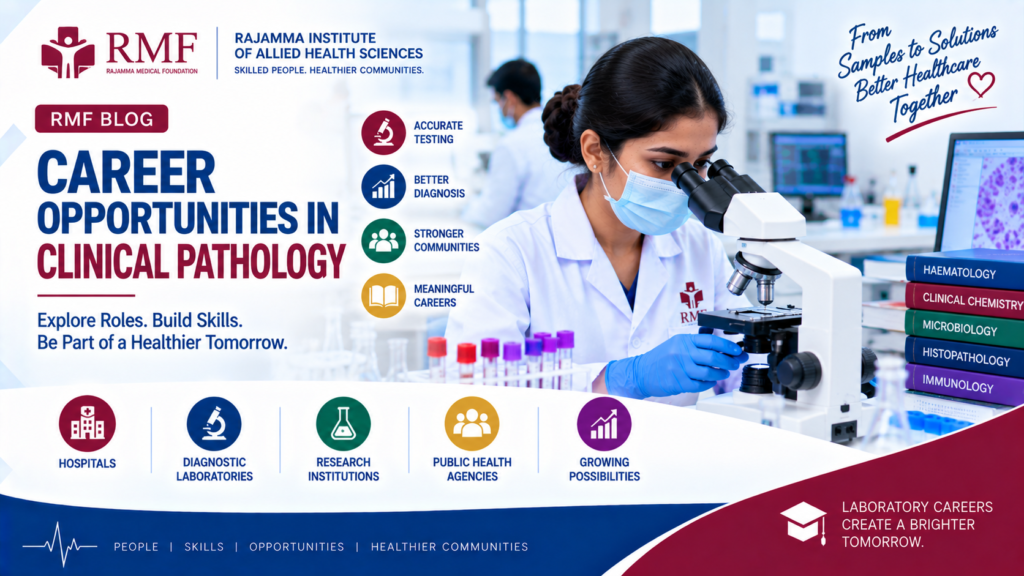
Career Opportunities in Clinical Pathology
Clinical pathology plays a significant role in modern healthcare. Laboratory investigations offer healthcare practitioners vital information needed in the diagnosis and management of various diseases and health conditions.
Behind every successful laboratory investigation, there are skilled and trained professionals who carry out the various duties involved in laboratory procedures.
For students considering healthcare careers but not willing to join mainstream specialisations like nursing and medical surgery, laboratory and clinical pathology present a viable option.
Understanding the various career opportunities, work environments and skills required can help students make informed decisions about their career path.
What is Clinical Pathology?
Clinical pathology is a specialty area of laboratory medicine that involves examining and analysing clinical specimens to generate information used in patient diagnosis and management.
Depending on the laboratory and the scope of duties, laboratory professionals in this specialty area undertake a range of duties related to:
- Clinical specimens testing and analysis
- Clinical chemistry
- Haematology
- Microbiology
- Specimen preparation
- Laboratory documentation
- Quality and laboratory safety control
The duties of laboratory professionals vary depending on the level of education, training, and work environment.
Why is Clinical Pathology Important?
Clinical pathology is critical to healthcare as it generates the information used by healthcare practitioners in the diagnosis and management of various health conditions.
In addition to clinical examinations and patient history, doctors rely on laboratory investigations to identify health problems and develop management plans.
This highlights the importance of laboratory investigations and the role of laboratory professionals in patient management.
Laboratory professionals should therefore carry out their duties with a high level of precision and adhere to the standard operating procedures.
Career Opportunities in Clinical Pathology
Clinical pathology offers a wide range of career opportunities in various healthcare organisations.
Depending on the scope of duties and the qualification, laboratory professionals can consider career opportunities in the following organisations:
- Hospitals
- Diagnostic laboratories
- Pathology laboratories
- Clinics
- Healthcare organisations
- Research institutions
- Public health agencies
- Other healthcare organisations offering laboratory services
Depending on the employer’s needs and the level of education, laboratory professionals can consider a wide range of laboratory-related careers.
Laboratory Assistant
A laboratory assistant usually works in a clinical laboratory and supports other laboratory professionals in various duties related to specimen collection, preparation, storage, and testing.
These professionals play a vital role in ensuring laboratory investigations are conducted in a controlled and sterile environment free from contaminants that may affect the test results.
Clinical Laboratory Support
Laboratory support professionals play a critical role in ensuring laboratories offer quality services to patients and other stakeholders.
Depending on their scope of duties, these professionals may carry out the following duties:
- Preparing laboratory reagents and specimens
- Assisting laboratory professionals with laboratory investigations
- Maintaining a clean and tidy laboratory environment
- Adhering to laboratory safety and standard operating procedures
- Recording laboratory findings
- Assisting laboratory professionals with laboratory duties
- Maintaining laboratory records
The responsibilities of these professionals vary depending on their work environment and level of education.
Working in Diagnostic Laboratories
Diagnostic laboratories offer a wide range of laboratory services to support the diagnosis and management of various health conditions.
Professionals working in this facility must understand the importance of accurate specimen identification, storage and handling procedures, laboratory safety procedures and accurate record-keeping.
Working in a diagnostic laboratory can also offer the opportunity to become familiar with modern laboratory equipment and technology.
Working in Hospital Laboratories
A hospital laboratory offers a wide range of laboratory services needed by other hospital departments. Working in a hospital laboratory can be exciting as laboratory professionals interact with other healthcare professionals to deliver quality services.
Depending on the scope of duties, laboratory professionals working in hospitals can carry out routine laboratory investigations and offer support to other hospital departments.
Career Opportunities in Pathology Laboratories
Pathology laboratories offer various laboratory services, including clinical pathology, anatomical pathology, and forensic pathology. Working in a pathology laboratory can be rewarding as these facilities usually offer state-of-the-art equipment needed for laboratory investigations.
The work environment in pathology laboratories is highly controlled to ensure high-quality services and patient safety.
Students considering this career opportunity need to gain quality education and training to acquire the necessary skills and knowledge.
Skills Needed for a Career in Clinical Pathology
While most laboratory professionals require technical expertise, there are also key skills that all laboratory professionals must possess.
These skills are needed to ensure high-quality laboratory services and include:
Attention to Detail
Laboratory investigations require laboratory professionals to adhere to precise instructions.
As such, these professionals require excellent attention to detail to avoid record-keeping errors and ensure accurate test results.
Laboratory Safety
Clinical pathology laboratory professionals usually handle biological specimens, laboratory equipment, and various chemicals. As such, these professionals require sound knowledge of laboratory safety procedures.
Sample Handling
Proper handling of clinical specimens is essential to ensure test accuracy and prevent laboratory-acquired infections. Laboratory professionals should therefore have good specimen-handling skills.
Equipment Knowledge
Modern laboratory investigations require professionals to operate various laboratory equipment. Students considering a laboratory career should therefore gain quality training to develop excellent equipment-handling skills.
Communication
Effective communication is crucial for laboratory professionals as they interact with various stakeholders, including healthcare practitioners and patients.
Teamwork
Most laboratory procedures are carried out in teams, and as such, teamwork is usually required. Laboratory professionals should be friendly and dependable team players.
Importance of Practical Training
Laboratory practical training is crucial as it enables students to gain first-hand experience in the various laboratory procedures.
Through practical training, students can obtain extensive knowledge of:
- Laboratory equipment
- Specimen handling procedures
- Laboratory safety and infection control
- Laboratory documentation and record-keeping
- Laboratory procedures and methodology
- Laboratory organisational skills
- Teamwork and collaboration
Practical training can also help students develop confidence in their ability to carry out laboratory investigations in a professional working environment.
Career Growth in Clinical Pathology
Various factors affect the rate of career growth of laboratory professionals, including education, training, and additional qualifications.
Students considering a career in clinical pathology should therefore identify the entry-level qualifications and consider acquiring additional training to advance their career.
Professional development is also crucial as it enables laboratory professionals to stay updated with the latest developments in laboratory practices.
Understanding the eligibility criteria for various laboratory careers can also help students determine the required qualifications and skills for each career.
Technology and the Future of Laboratory Careers
Modern clinical pathology laboratories are adopting new technologies to improve the efficiency and accuracy of laboratory investigations.
As such, future laboratory professionals need to be aware of the importance of acquiring digital skills to support their career.
The ability to operate modern laboratory equipment and adhere to new procedures will also be crucial for future laboratory careers.
Clinical Pathology Education at Rajamma Institute of Allied Health Sciences
Rajamma Medical Foundation (RMF) through the Rajamma Institute of Allied Health Sciences offers quality education and training to produce ethical and competent healthcare practitioners.
Students interested in allied healthcare careers can consider obtaining quality education and training to develop the requisite technical expertise, practical skills and professional competence to support their career.
Students can acquire foundational knowledge and practical experience in clinical pathology to prepare them for a rewarding healthcare career.
Building a Career in Clinical Pathology
While most laboratory professionals require technical expertise, there are also key skills that all laboratory professionals must possess.
Students considering a career in clinical pathology should therefore focus on developing the following:
- Technical expertise
- Laboratory safety skills
- Specimen-handling expertise
- Attention to detail
- Equipment handling skills
- Communication skills
- Teamwork and collaboration
- Documentation skills
- Digital skills
- Professionalism
- Adaptability and flexibility
- Ongoing professional development
With the right education and training, students can develop the necessary proficiencies needed to pursue a successful laboratory career.
Frequently Asked Questions
1. What are the career opportunities in clinical pathology?
Students considering a career in clinical pathology can explore laboratory-related careers in hospitals, diagnostic laboratories, pathology laboratories, clinics, public health agencies, and other healthcare organisations offering laboratory services.
2. What does a laboratory assistant do?
A laboratory assistant carries out various duties related to specimen collection, preparation, storage, and testing while adhering to laboratory safety guidelines.
3. What skills are important for clinical pathology careers?
Important skills for clinical pathology careers include technical expertise, attention to detail, laboratory safety knowledge and procedures, specimen-handling skills, equipment handling procedures, record-keeping and communication skills.
4. Is practical training important for laboratory careers?
Yes, practical training is vital as it provides students with first-hand experience in laboratory procedures.
5. Where can students learn skills for laboratory careers?
Students can develop laboratory skills through quality education and practical training. Rajamma Institute of Allied Health Sciences offers relevant training to help students learn laboratory procedures and develop the necessary skills for a rewarding healthcare career.