
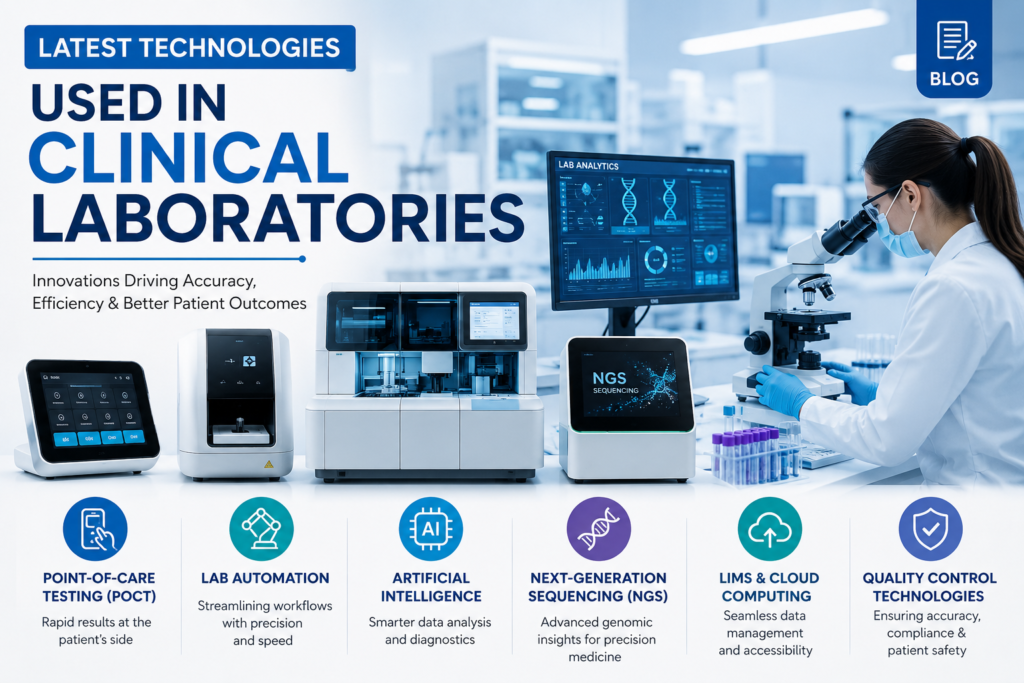
Latest Technologies Used in Clinical Laboratories
Clinical laboratories play an essential role in modern healthcare. Laboratory tests help doctors diagnose diseases, monitor treatment, assess organ function, and make informed medical decisions. With rapid advances in medical technology, laboratories are becoming faster, more accurate, automated, and efficient.
Today, modern clinical laboratories use advanced instruments, automation, digital systems, and molecular technologies to improve the quality of patient care.
What Are Clinical Laboratory Technologies?
Clinical laboratory technologies include the equipment, software, diagnostic methods, and automated systems used to examine patient samples such as blood, urine, tissue, and other biological specimens.
These technologies help laboratory professionals perform tests with greater accuracy while reducing manual errors and improving turnaround time.
Latest Technologies Used in Clinical Laboratories
1. Laboratory Automation
Automation has transformed laboratory workflows. Automated systems can handle activities such as sample sorting, labeling, transportation, preparation, and testing.
Automation helps reduce repetitive manual work, improve consistency, and process a large number of samples efficiently.
2. Artificial Intelligence and Machine Learning
Artificial Intelligence (AI) and Machine Learning (ML) are increasingly being explored in laboratory medicine. These technologies can assist with analyzing complex laboratory data, identifying patterns, flagging abnormal results, and supporting diagnostic decision-making.
AI-based systems can also help laboratories improve workflow management and quality control.
3. Molecular Diagnostic Technologies
Molecular diagnostics allow laboratories to detect genetic material such as DNA and RNA. Technologies such as Polymerase Chain Reaction (PCR) are widely used for detecting infections and identifying specific genetic or molecular markers.
These techniques can provide highly sensitive and specific results and are important in infectious disease testing, genetic testing, and oncology.
4. Next-Generation Sequencing
Next-Generation Sequencing (NGS) enables laboratories to examine large amounts of genetic information simultaneously.
NGS has applications in genetic disease investigation, cancer research, infectious disease analysis, and personalized medicine. As sequencing technologies continue to advance, they are becoming increasingly useful in modern diagnostic laboratories.
5. Point-of-Care Testing
Point-of-care testing allows certain diagnostic tests to be performed close to the patient rather than exclusively inside a central laboratory.
Examples include blood glucose testing, some blood gas analyses, and selected infectious disease tests. Faster access to results can support timely clinical decisions.
6. Digital Pathology
Digital pathology uses high-resolution scanners and digital platforms to convert microscope slides into digital images.
Pathologists can review, store, share, and analyze these images digitally. Digital pathology can also support remote consultations, education, research, and computer-assisted image analysis.
7. Advanced Immunoassay Systems
Modern immunoassay analyzers can perform tests for hormones, enzymes, antibodies, tumor markers, and other biological substances.
Automated immunoassay systems help laboratories handle high workloads while maintaining standardized testing procedures.
8. Advanced Hematology Analyzers
Modern hematology analyzers can perform comprehensive blood cell analysis quickly and accurately.
They can measure parameters related to red blood cells, white blood cells, platelets, and other hematological characteristics. Advanced systems may also provide automated flags that indicate samples requiring further review.
9. Laboratory Information Systems
Laboratory Information Systems (LIS) help laboratories manage patient information, test orders, sample tracking, results, quality control, and reporting.
Integration between LIS platforms and laboratory instruments can reduce manual data entry and improve traceability throughout the testing process.
10. Robotic Sample Handling
Robotic systems can transport and process laboratory specimens with minimal manual intervention.
They can help improve sample identification, reduce handling errors, and increase laboratory productivity, particularly in high-volume diagnostic centers.
Benefits of Modern Laboratory Technologies
The adoption of advanced technologies offers several important benefits:
- Faster processing and turnaround times
- Improved accuracy and consistency
- Reduced manual errors
- Better sample tracking
- Efficient handling of high workloads
- Improved laboratory workflow
- Enhanced quality control
- Better integration of laboratory data
- Support for faster clinical decision-making
The Future of Clinical Laboratories
The future of laboratory medicine is expected to involve greater integration of automation, artificial intelligence, molecular diagnostics, digital pathology, robotics, and data-driven technologies.
At the same time, skilled laboratory professionals will remain essential. Technology can improve laboratory processes, but trained professionals are needed to operate equipment, monitor quality, interpret results appropriately, and maintain patient safety.
Why Students Should Understand Modern Laboratory Technology
Students interested in Medical Laboratory Technology and allied healthcare fields can benefit from understanding how modern diagnostic laboratories operate.
Learning about automated analyzers, molecular diagnostics, laboratory information systems, quality control, and digital laboratory workflows can help students develop knowledge that is relevant to today’s healthcare environment.
Practical exposure to modern laboratory procedures can also help students build confidence and prepare for careers in diagnostic laboratories, hospitals, clinics, research facilities, and other healthcare settings.
Conclusion
Modern clinical laboratories are evolving rapidly through automation, artificial intelligence, molecular diagnostics, digital pathology, robotics, and advanced laboratory information systems. These technologies are helping laboratories improve efficiency, accuracy, and turnaround time while supporting better patient care.
For aspiring healthcare professionals, understanding these developments is an important step toward building a strong foundation in modern laboratory medicine.
Frequently Asked Questions
1. What is laboratory automation?
Laboratory automation uses automated instruments and systems to perform and manage laboratory processes with reduced manual intervention.
2. How is AI used in clinical laboratories?
AI can assist with data analysis, pattern recognition, abnormal-result flagging, workflow optimization, and other laboratory applications.
3. What is molecular diagnostics?
Molecular diagnostics involves detecting or analyzing genetic material such as DNA or RNA to help identify diseases and biological markers.
4. What is digital pathology?
Digital pathology involves scanning microscope slides and examining them as high-resolution digital images using specialized software and systems.
5. Why are modern laboratory technologies important?
They can improve testing efficiency, accuracy, sample traceability, turnaround time, and overall laboratory workflow.
6. Can students learn about these technologies in medical laboratory programs?
Yes. Students in relevant Medical Laboratory Technology and allied healthcare programs can learn about laboratory procedures, diagnostic equipment, automation, quality control, and emerging technologies as part of their education and practical training.