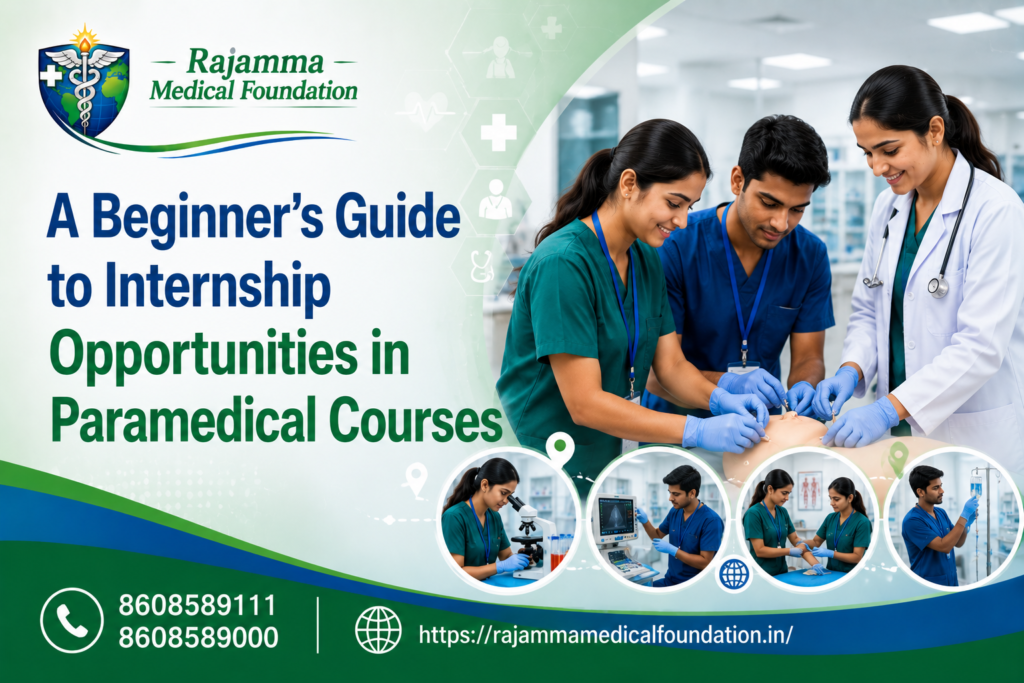
A Beginner’s Guide to Internship Opportunities in Paramedical Courses
Starting a paramedical course is an exciting step toward a healthcare career, but classroom learning alone is not enough to become a skilled professional. This is where internships make a significant difference. A Paramedical Course Internship Guide helps students understand how practical training prepares them for real hospital environments and future employment. At Rajamma Institute of Allied Health Sciences (RIAHS), a unit of Rajamma Medical Foundation (RMF), students are encouraged to combine academic knowledge with clinical exposure, enabling them to develop the confidence and competence required in the healthcare industry.
If you are new to paramedical education, this guide explains everything you need to know about internships and why they are an essential part of your learning journey.
What Is an Internship in a Paramedical Course?
An internship is a supervised training period where students work in hospitals, laboratories, or healthcare facilities to apply what they have learned in the classroom.
Unlike theoretical lessons, internships expose students to real healthcare situations, allowing them to observe professionals, use medical equipment, and understand patient care procedures.
The objective is to prepare students for professional responsibilities before they begin their careers.
Paramedical Course Internship Guide: What Can You Expect?
Many students feel nervous before starting their first internship. Knowing what to expect can help reduce anxiety and improve the learning experience.
Clinical Observation
Initially, students observe experienced healthcare professionals to understand hospital workflows and patient care practices.
Hands-on Learning
As students become familiar with procedures, they gradually perform tasks under proper supervision.
Team Collaboration
Internships teach students how doctors, nurses, technicians, and other healthcare professionals work together to provide quality patient care.
Professional Conduct
Students also learn workplace discipline, communication, confidentiality, and ethical responsibilities.
Skills You Can Develop During an Internship
An internship helps students build practical skills that employers value.
Some of these include:
- Clinical competency
- Medical equipment handling
- Patient communication
- Documentation and record management
- Infection control practices
- Time management
- Critical thinking
- Teamwork and collaboration
These abilities prepare students to transition smoothly into professional healthcare roles.
Common Internship Areas in Paramedical Education
Depending on the chosen specialization, students may complete internships in different healthcare departments.
Some examples include:
- Clinical Laboratories
- Radiology Departments
- Operation Theatres
- Emergency and Trauma Units
- Dialysis Centres
- Intensive Care Units
- Blood Collection and Diagnostic Services
- Rehabilitation Centres
Each department offers valuable practical experience and exposure to different aspects of healthcare.
Tips for a Successful Internship Experience
Students can gain the maximum benefit from their internship by following these simple practices:
- Arrive on time every day.
- Wear appropriate professional attire.
- Respect patient privacy and confidentiality.
- Ask questions whenever guidance is needed.
- Keep a notebook to record important observations.
- Accept feedback positively and work on improvement.
- Follow hospital safety protocols at all times.
Developing these habits early helps students become responsible healthcare professionals.
Conclusion
Internships are one of the most valuable components of healthcare education because they transform theoretical learning into practical expertise. This Paramedical Course Internship Guide highlights how clinical exposure helps students develop technical skills, confidence, and professional behavior. Rajamma Institute of Allied Health Sciences (RIAHS), a proud unit of Rajamma Medical Foundation (RMF), is committed to providing students with quality education supported by practical training and real-world healthcare exposure. Students who wish to build successful careers in the paramedical field can begin their educational journey at RIAHS with confidence and purpose.
Frequently Asked Questions (FAQs)
1. When do students usually begin internships in paramedical courses?
The internship period depends on the curriculum of the specific course. Many programs include clinical training during the later stages of study.
2. Do interns receive supervision during hospital training?
Yes. Internships are generally conducted under the guidance of experienced healthcare professionals who monitor and support students throughout their training.
3. Does Rajamma Institute of Allied Health Sciences (RIAHS) emphasize practical learning?
Yes. RIAHS integrates practical laboratory sessions and clinical exposure into its educational approach to prepare students for healthcare careers.
4. How does RIAHS support students during their healthcare education?
As a unit of Rajamma Medical Foundation (RMF), RIAHS focuses on academic excellence, skill development, and practical learning that equips students for the healthcare industry.
5. Can internship experience improve confidence before graduation?
Absolutely. Clinical internships help students understand real hospital environments, strengthen practical skills, and build confidence before entering the workforce.