Beginner’s Guide to Practical Training in Healthcare Courses
Picking a healthcare course can be an exhilarating move in the direction of a fulfilling profession. On the other hand, a lot of students and their parents tend to give importance only to the theory part without realizing how practical experience matters. This beginner’s guide to practical training in healthcare courses highlights the significance of hands-on practice as an essential component of healthcare education.
At Rajamma Institute of Allied Health Sciences (RIAHS), a unit of Rajamma Medical Foundation (RMF), students are motivated to integrate theoretical learning with practical training so as to equip themselves with fundamental professional skills required in the healthcare sector.
What Is Practical Training in Healthcare Courses?
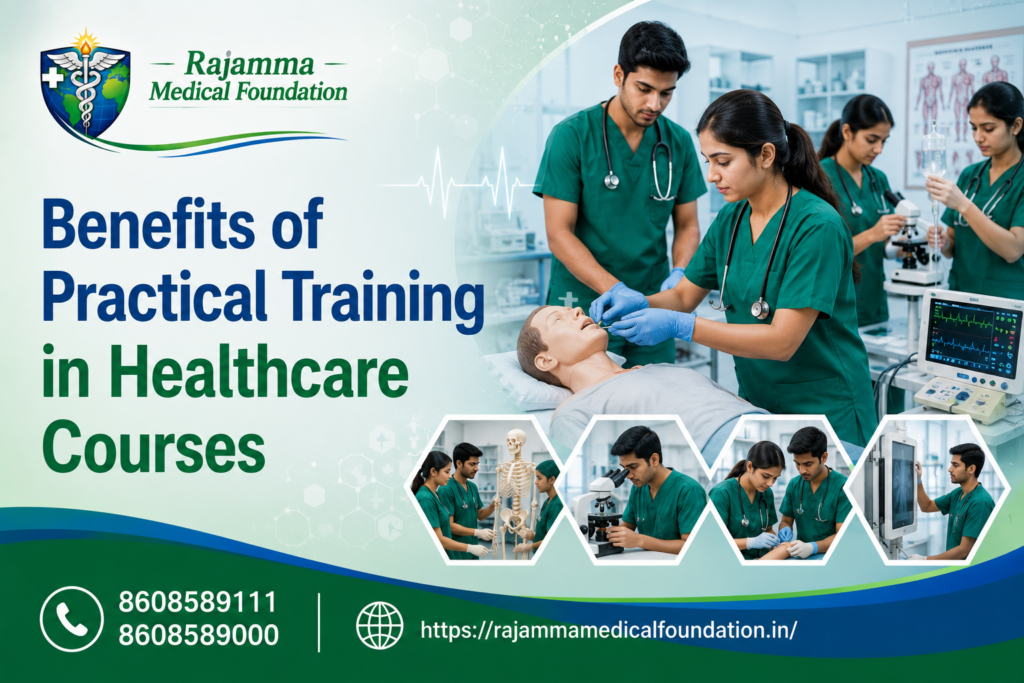
Practical training is when you learn by doing things. You do not just read books you do tasks that are related to healthcare in labs, simulation centers and real healthcare settings. You do these tasks with the help of teachers who have a lot of experience.
This way of learning helps students see how things are done in life like medical procedures, diagnostic techniques and taking care of patients. Practical training helps students understand what they learned in class and how to use it when they are actually working in the healthcare field. It helps connect what you learn in school to what you do, on the job, which’s really important for healthcare students to learn practical training and become good at it through practical training.
Why Beginners Should Not Ignore Practical Learning
A lot of students think that getting marks is all they need to get a good job.. The truth is, healthcare employers want more than that. They want healthcare students who can do their healthcare jobs well and feel confident, about their healthcare skills. Healthcare employers look for people who can handle the work that comes with being a healthcare professional.
Practical training helps beginners:
- Understand real healthcare environments
- Learn the correct use of medical instruments
- Develop confidence before internships
- Practice safety and hygiene standards
- Improve professional communication
These experiences prepare students to handle responsibilities with greater accuracy and confidence.
How Practical Training Usually Works
Laboratory Sessions
Students first practice procedures in well-equipped laboratories where they learn basic techniques in a controlled environment.
Simulation-Based Learning
Modern healthcare education often includes simulated patient scenarios. Students can practice responding to emergencies, performing assessments, and following treatment protocols without risk to actual patients.
Clinical Observation
Before actively participating, students observe experienced healthcare professionals to understand hospital workflows, patient interaction, and teamwork.
Supervised Clinical Practice
As students progress, they perform selected procedures under expert supervision, helping them gain confidence while maintaining patient safety.
Common Mistakes Students Make
Focusing Only on Theory
Healthcare education requires both knowledge and practical application. Ignoring practical sessions can limit skill development.
Hesitating to Ask Questions
Practical training is the best time to clarify doubts. Asking questions helps students learn correct techniques early.
Avoiding Team Activities
Healthcare professionals work as a team. Participating in group exercises helps students improve coordination and communication.
Not Practicing Regularly
Skills improve with repetition. Students who actively participate in practical sessions usually perform better during internships and employment.
How to Choose a College with Good Practical Exposure
Before taking admission, students should consider:
- Availability of modern laboratories
- Experienced teaching faculty
- Clinical training opportunities
- Skill-based learning methods
- Industry-oriented curriculum
- Student support during practical sessions
These factors contribute significantly to overall learning and career readiness.
Conclusion
To become a healthcare professional you need to know how important it is to learn by doing things. This guide for people who’re new to healthcare training shows how doing things with your own hands helps you learn technical things feel confident and be ready to work.
If you want to learn about healthcare and actually do things to learn you can look at Rajamma Institute of Allied Health Sciences.
Rajamma Institute of Allied Health Sciences is part of Rajamma Medical Foundation so it helps students learn skills that they will actually use and also learn things in the classroom to get them ready for jobs, in healthcare. Rajamma Institute of Allied Health Sciences does this to help students get jobs in the healthcare sector.
Frequently Asked Questions
1. What is the main purpose of practical training in healthcare courses?
ANS The main purpose is to help students apply theoretical concepts in real or simulated healthcare settings while developing clinical and professional skills.
2. Is practical training suitable for students with no medical background?
ANS Yes. Practical sessions are designed to help beginners gradually learn healthcare procedures under faculty guidance, regardless of prior experience.
3. How does practical training improve confidence?
ANS Regular hands-on practice allows students to become familiar with medical equipment, patient interaction, and healthcare procedures, reducing fear and increasing confidence.
4. What healthcare programs are available at RIAHS?
ANS Rajamma Institute of Allied Health Sciences (RIAHS) offers various allied health science programs designed to combine academic learning with practical skill development. Students can explore the institution’s courses and admission details to find the program that matches their career goals.
5. Why should students choose RIAHS for healthcare education?
ANS RIAHS, a unit of Rajamma Medical Foundation (RMF), emphasizes practical learning, experienced faculty, and industry-focused education to help students become competent healthcare professionals.