Career Skills Needed for Modern Laboratory Assistants
Labs are very important in providing modern health care services. The services range from conducting blood tests and pathological tests to processing samples and diagnosing patients. Lab technicians are responsible for ensuring that modern healthcare services are delivered efficiently.
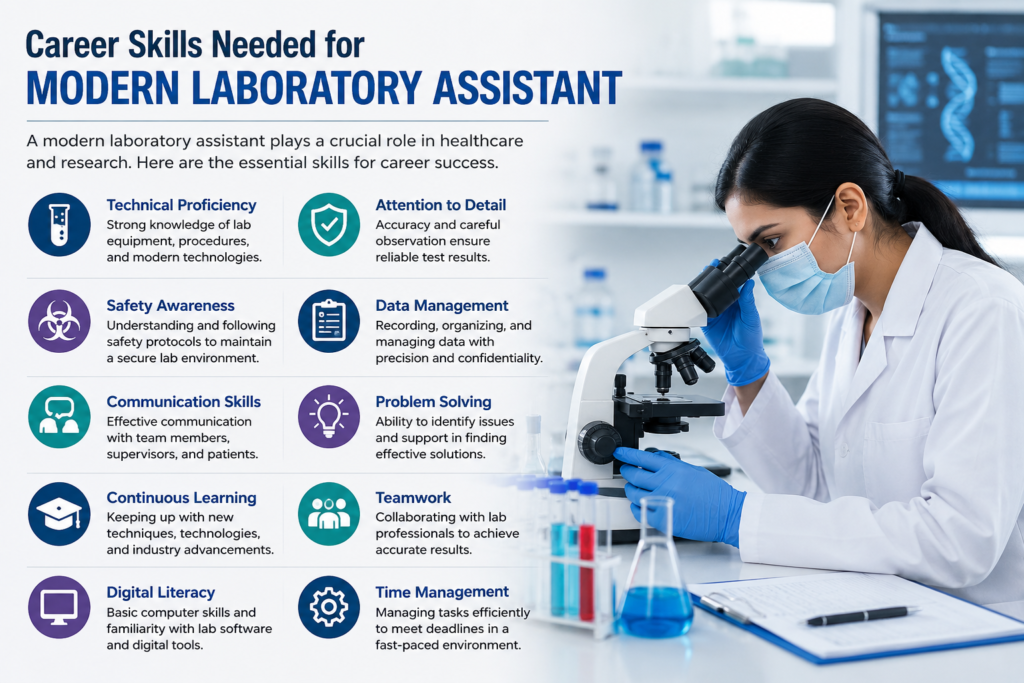
Modern laboratories are technology driven and, therefore, the modern laboratory assistants require not just simple technical skills. Today, laboratory assistants require laboratory skills, attention to detail, computer skills, communication skills, safety knowledge and professionalism.
If you intend to develop your career as a laboratory assistant, then knowing what these skills are will help you prepare for the modern health care industry.
What Does a Modern Laboratory Assistant Do?
The lab assistant assists laboratory professionals in the preparation, handling, processing, recording, and managing of clinical samples and laboratory processes.
Depending on the place of work and duties of the lab assistant, his or her duties will involve:
Receiving and labeling specimens
Preparation of samples for testing
Maintenance of laboratory instruments and laboratory areas
Adherence to laboratory safety procedures
Recording of laboratory data
Assistance in performing laboratory processes
Maintenance of laboratory equipment and stock
Assistance to the laboratory professionals
Infection control and hygiene practices
Communication of critical information to the lab team
Accuracy is especially important because laboratory work is linked to the process of making decisions in the field of healthcare. Therefore, professional laboratories need assistants who will be able to perform their duties accurately and consistently.
1. Good Attention to Detail
Attention to detail is one of the key skills for laboratory assistants.
Any inaccuracy with labelling, handling of the samples, keeping records, or following the procedure may influence the laboratory work.
Good attention to detail means:
Checking patient and specimen information
Labeling samples properly
Following the procedure
Recording the observations correctly
Checking the equipment and materials
Reporting the unusual situation to the appropriate professional
The practice of double checking helps to keep the accuracy and professionalism of the assistant.
2. Working with the Laboratory Equipment
Modern laboratories use a wide range of laboratory equipment and devices. Laboratory assistants need to have basic knowledge about the purpose of the equipment and safe handling of the laboratory equipment.
Depending on the education and workplace, they may work with such equipment as:
Microscopes
Centrifuges
Pipettes
Balances
Incubators
Automated laboratory systems
Sterilization equipment
It is important to have hands-on experience of working with the laboratory equipment under the appropriate supervision.
3. Proper Specimen Collection and Handling
Specimen handling is a critical aspect of laboratory workflow.
Laboratory assistants should be aware of:
Specimen identification
Suitable collection containers
Proper specimen transportation
Storage conditions
Preventing specimen contamination
Specimen handling protocols
Every single specimen must be properly collected and handled.
4. Laboratory Safety Awareness
Laboratory safety is always of prime concern in a clinical laboratory.
Laboratory assistants have to work among biological specimens, chemicals, sharps, equipment, and many other possible hazards. They must thus be knowledgeable about the necessary safety precautions and adhere to the safety policies of their workplace.
Important areas of safety knowledge include:
Personal protective equipment
Hand hygiene
Proper specimen handling
Sharps safety
Chemical safety
Segregation of waste
Disinfection and sterilization procedures
Infection control procedures
Emergency procedures
An aware laboratory assistant can protect patients, other workers, and laboratory environment.
5. Basic Computer Skills and Knowledge of Digital Technologies
Modern laboratory operations cannot function without technology.
Modern laboratory professionals work in computerized environment where documentation, data entry, report generation, inventory control, and laboratory workflow management take place.
Modern laboratory assistants should thus acquire some basic digital skills, including:
Computer operation
Data entry
Microsoft Office software suite or equivalent software
Digital documentation
Basic laboratory information systems
Maintain electronic records
Handling accurate reports
The comfort level with technology may assist students with adapting to modern healthcare workplace environment.
6. Communication Skills
Laboratory assistants operate as a member of the healthcare team and can interact with laboratory technicians, physicians, nurses, administrative staff, patients, and other healthcare professionals.
Clear communication assists in preventing misunderstandings and efficient operation of laboratories.
Among the important communication skills one needs to possess:
Active listening
Clear speaking
Compliance with instructions
Questions when something requires clarification
Proper reporting of any problem situations
Proper behavior
Technical knowledge is very helpful when combined with effective communication.
7. Time Management and Organization
Laboratories can have a lot of samples, procedures, records, and responsibilities to perform simultaneously.
The good laboratory assistant should know how to organize his tasks and work in such a way that he will manage his time properly without compromising the accuracy of his performance.
Some helpful tips:
Task prioritization
Organization of working area
Maintaining proper documentation
Material preparation before starting any procedure
Observance of schedule
Performing assigned tasks systematically
Good organization allows laboratory teams maintaining efficient workflow.
8. Basic Analytical and Problem Solving Skills
Laboratory assistants should train themselves in observing well and identifying situations that may require some attention.
Some examples are:
Mislabeling and incomplete labeling
Specimen problems
Problems with equipment
Lack of information
Unusual observations
Errors in workflow
Not only does the job involve doing monotonous jobs. Today’s healthcare environment requires professionals who can observe well, think well, adhere to procedures, and communicate their concerns.
9. Team Work And Professional Discipline
Healthcare is a team profession. Laboratory assistants must work well with other professionals of the healthcare team.
Some features of professional teamwork include:
Respect to colleagues
Adherence to instructions
Cooperation
Punctuality
Taking responsibility for assigned tasks
Compliance with workplace policy
Maintaining confidentiality
Professionals that employers prefer are dependable, responsible and learners.
10. Lifelong Learning
Technology and practices used in laboratory are evolving. A good laboratory assistant should have an attitude of willingness to learn new procedures, technology, equipment and practices at the workplace.
Examples of lifelong learning could be attending:
Workshops
Practical trainings
Learning new laboratory technology
Computer skills development
Safety knowledge update
Communication skills development
Clinical experience
Lifelong learning can keep healthcare professionals up to date in an ever-changing field.
Importance of Practical Training
Reading laboratory concepts from books is essential, but practical experience makes it possible to get a better understanding of how they are used in practice within the realm of healthcare.
Practical training will allow you to get acquainted with:
Laboratory techniques
Handling equipment
Processing samples
Safety practices
Documentation
Work discipline
Team communication
The Rajamma Institute of Allied Health Sciences stresses importance of practical healthcare education and training for students, in addition to clinical and skill training. The institute offers Advanced Diploma in Clinical Pathology & Lab Assistant with OJT, which is a great way for those interested in developing laboratory skills.
Career Options for Laboratory Assistants
Having got adequate education and training, laboratory-related professionals can try to get work in various healthcare and diagnostic facilities, based on their qualifications and employer needs.
Among such work places there are:
Hospitals
Diagnostic laboratories
Pathology laboratories
Medical centers
Clinics
Research laboratories
Healthcare organizations
Other laboratories
Career advancement depends on one’s qualifications, practical experience, further training, employer needs, etc.
How to Make a Successful Career in Laboratory
If you want to become a laboratory assistant, you should work on three spheres at once:
Knowledge
Get acquainted with basic subjects related to laboratory sciences, pathology,
Practical Skills
Get guided hands-on exposure to laboratory practices, equipment, sample management, safety protocols, and documentation.
Professional Skills
Learn effective communication, teamwork, self-discipline, time management, computer skills, and meticulousness.
Such a combination will help you to be more prepared for the demands of the contemporary healthcare workplace.
Conclusion
Contemporary laboratory assistant is not only a person who assists in everyday laboratory procedures. They are an integral part of the healthcare team and should combine technical expertise with precision, safety awareness, technological proficiency, communication skills, and professionalism.
If you have a passion for healthcare, science, and laboratory work, acquiring such skills will be an essential starting point for the beginning of your career.
Start your learning process. Acquire practical skills. Develop professional competence. Prepare yourself for the future of healthcare.
Acquire Your Healthcare Career with Rajamma Institute of Allied Health Sciences
Rajamma Institute of Allied Health Sciences offers allied healthcare education with practical training, clinical experience, skill development, career counseling, and internship placement services.
Discover the opportunities to gain Diploma in Clinical Pathology & Lab Assistant and Advanced Diploma in Clinical Pathology & Lab Assistant with OJT programs for laboratory-related healthcare career path.
A successful healthcare career may be launched through proper skills, proper training, and proper desire to learn
Frequently Asked Questions (FAQs)
1. What skill set is required for a laboratory assistant?
A laboratory assistant must be skilled in attention to detail, sample handling, knowledge of laboratory equipment, safety precautions, computers, communication, teamwork, time management, and analytical skills.
2. Why is attention to detail a necessary skill for a laboratory assistant?
Attention to detail ensures that a laboratory assistant accurately identifies samples, adheres to protocols, maintains accurate records and minimizes the chances of making an error during laboratory operations.
3. Does a laboratory assistant need to know computers?
Yes. With the advancement of technology, many laboratories use computerized equipment in their work and documentation and data entry. Therefore, computers can be useful to a laboratory assistant.
4. What laboratory equipment does a laboratory assistant need to know about?
Depending on the training and workplace, a laboratory assistant works with various pieces of laboratory equipment such as microscopes, centrifuges, pipettes, balances, incubators, sterilizers and automated laboratory equipment.
5. Why is laboratory safety important?
Laboratory safety ensures the protection of health care professionals, patients, specimens and laboratory workplaces. It entails knowledge of personal protective equipment, proper handling of specimens, disposal of wastes, hygiene and workplace safety.