Hospital-Based Learning versus Classroom Learning
Healthcare education includes both knowledge and practical understanding. Students need to learn concepts, procedures and professional principles in the classroom but they also need opportunities to understand how healthcare environments work in practice.
This creates a difference between classroom learning and hospital-based learning.
Classroom education gives the academic foundation students need for their chosen field. Hospital-based learning gives exposure to healthcare environments, workplace routines, teamwork and practical responsibilities.
Than replacing each other these two forms of learning can work together.
For students preparing for healthcare careers understanding the value of both can help them make use of their education and practical training.
What is Classroom Learning?
Classroom learning is the part of healthcare education where students develop theoretical knowledge related to their course.
Students may learn concepts through:
- Lectures
- Study materials
- Discussions
- Demonstrations
- Assignments
- Assessments
- Academic activities
Classroom learning helps students understand the principles behind healthcare procedures and professional responsibilities.
It provides the foundation on which practical learning can be developed.
What is Hospital-Based Learning?
Hospital-based learning gives students exposure to a healthcare environment as part of their education and training.
Depending on the course training programme and permitted responsibilities students may. Take part in appropriate supervised activities.
Hospital-based learning can introduce students to:
- Professional healthcare environments
- Workplace routines
- Healthcare team communication
- Patient-care environments
- Equipment and procedures
- Documentation
- Safety practices
- Clinical workflows
- responsibilities
The exact nature of hospital-based learning depends on the students qualification, course and training arrangement.
Classroom Learning Builds the Foundation
Before students can apply knowledge in an environment they need to understand the underlying concepts.
Classroom learning can help students develop knowledge about their chosen field and understand why particular procedures and practices are important.
For example a student may learn about laboratory procedures healthcare support, safety or communication before encountering these areas in a setting.
This theoretical foundation can make practical learning easier to understand.
Hospital-Based Learning Connects Knowledge With Practice
Hospital-based learning can help students see how classroom concepts relate to healthcare environments.
A concept that may seem abstract during a lecture can become easier to understand when students observe how professionals apply procedures and responsibilities.
This connection between theory and practice is one of the advantages of practical exposure.
Students can begin to understand:
- How procedures are organised
- How healthcare teams coordinate their work
- How workplace responsibilities are assigned
- How safety practices are followed
- How communication takes place
- How professional routines are maintained
Difference Between Classroom and Hospital-Based Learning
Although both are important the learning experience can be different.
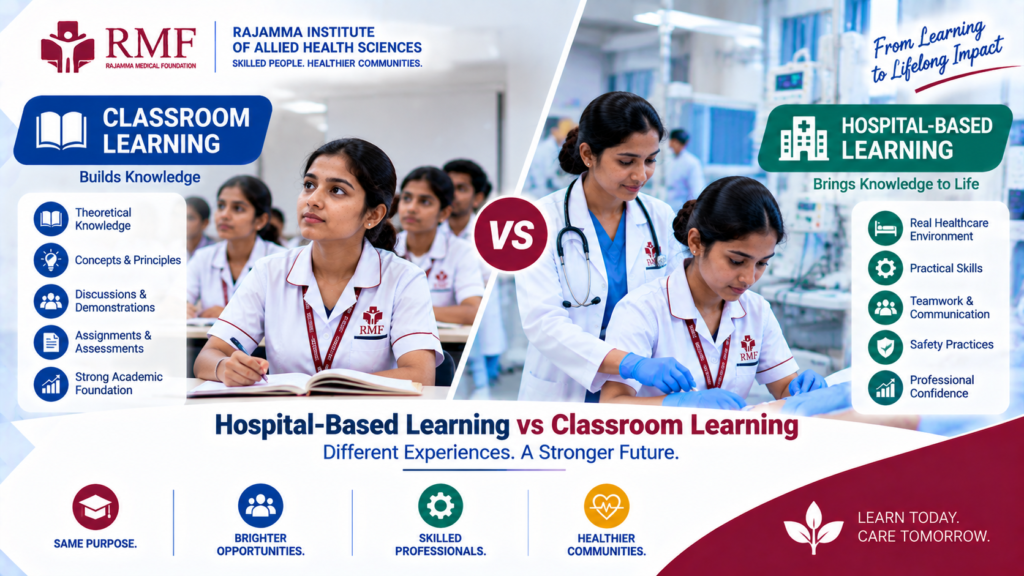
Classroom Learning
Classroom learning generally focuses on:
- knowledge
- Academic concepts
- Course-related principles
- Structured lessons
- Written assignments
- Assessments
- understanding
Hospital-Based Learning
Hospital-based learning generally focuses more on:
- Practical exposure
- Workplace routines
- Professional behaviour
- Teamwork
- Communication
- Equipment familiarity
- Safety practices
- Clinical or healthcare workflows
The two approaches work best when students can connect what they learn academically with what they observe and experience during practical training.
Developing Practical Skills
Healthcare careers require practical skills in addition to theoretical knowledge.
Hospital-based learning can provide students with opportunities to become familiar with equipment, procedures and workflows under appropriate supervision.
Depending on the field students may gain exposure to:
- Equipment handling
- Sample-related activities
- Patient-support activities
- Documentation
- Workplace procedures
- Safety practices
- Infection-control practices
- laboratory workflows
Practical activities should always be appropriate to the students training level and carried out according to supervision and workplace requirements.
Learning Professional Communication
Communication is a part of healthcare.
In a classroom students can learn communication principles and professional behaviour. In a hospital environment they can observe how healthcare professionals communicate with colleagues and other members of the healthcare team.
Students can become familiar with the importance of:
- Listening
- Communicating respectfully
- Following instructions
- Asking appropriate questions
- Sharing relevant information
- Maintaining professional behaviour
Practical exposure can help students understand how communication works in a professional environment.
Understanding Healthcare Teamwork
Healthcare involves different professionals working together.
Classroom education can introduce students to roles and responsibilities while hospital-based learning can help them observe how different professionals coordinate their work.
Students can learn about:
- Cooperation
- Team communication
- Respect for professional roles
- Reliability
- Shared responsibility
- Workplace coordination
Understanding teamwork can help students prepare for healthcare environments.
Building Confidence Through Practical Exposure
Students may feel uncertain when entering a healthcare environment for the first time.
Hospital-based learning can help them become more familiar with the workplace and gradually develop confidence.
By observing professionals and becoming familiar with workplace routines students can gain a better understanding of what is expected from them.
This can help them feel more prepared when they eventually enter employment.
Learning Workplace Discipline
Classroom education generally follows a schedule while professional healthcare environments have their own routines and responsibilities.
Hospital-based learning can help students understand workplace expectations such as:
- Punctuality
- Professional conduct
- Following instructions
- Responsibility
- Time management
- Respect for workplace procedures
- Safety awareness
Developing these habits during training can help students prepare for life.
Understanding Safety in a Real Environment
Safety is a part of healthcare education.
Students can learn safety principles in the classroom. Practical exposure can help them understand how those principles are incorporated into everyday workplace activities.
Depending on their training environment students may become familiar with:
- Hand hygiene
- protective equipment
- Safe equipment handling
- Workplace cleanliness
- Infection-control practices
- Waste management
- Safe specimen handling
- Appropriate reporting of problems
Learning how safety procedures fit into daily workflows can strengthen students understanding of professional responsibility.
The Importance of Observation
Hospital-based learning is not about performing practical activities.
Observation itself can be a learning experience.
Students can observe how experienced professionals:
- Organise their work
- Communicate with colleagues
- Use equipment
- Follow procedures
- Manage responsibilities
- Maintain professional standards
- Work as part of a team
These observations can help students understand aspects of healthcare work that may be difficult to appreciate from classroom education alone.
How Classroom and Hospital Learning Complement Each Other
The learning experience can come from combining both approaches.
Classroom learning can answer questions such as:
- What’s this procedure?
- Why is it important?
- What principles are involved?
Hospital-based learning can help students explore:
- How is this applied in an environment?
- How do healthcare teams use this knowledge?
- What workplace responsibilities are involved?
Together theory and practical exposure can provide a complete educational experience.
Hospital-Based Learning and Job Readiness
Being job-ready involves more than completing a programme.
Students also need to understand workplace expectations and develop professional habits.
Hospital-based learning can help students become familiar with:
- Workplace environments
- Professional communication
- Teamwork
- Safety procedures
- Practical workflows
- Time management
- Responsibility
- Professional discipline
This exposure can help make the transition from education to employment more comfortable.
Which is Better: Classroom or Hospital-Based Learning?
It is not necessarily a question of choosing one over the other.
Classroom learning and hospital-based learning serve purposes.
Classroom education provides the knowledge and concepts students need to understand their field.
Hospital-based learning provides exposure that can help students understand how those concepts relate to professional healthcare environments.
For healthcare education both forms of learning can be valuable when they are appropriately integrated.
How Students Can Make the Most of Both
Students can maximise their learning by connecting their classroom and practical experiences.
Pay Attention to Theory
Build an understanding of the concepts taught during academic sessions.
Observe During Training
Pay attention to how professionals apply procedures and organise their responsibilities.
Ask Appropriate Questions
When something is unclear asking questions at the time can improve understanding.
Take Feedback Seriously
Feedback can help students identify areas for improvement.
Maintain Professional Discipline
Punctuality, responsibility, respect and appropriate behaviour are important in both education and professional environments.
Keep Learning
Use both practical experiences as opportunities for continuous development.
Hospital-Based Learning Across Healthcare Fields
The nature of hospital-based learning can vary depending on the students field.
Students preparing for pathology and laboratory-related careers may gain exposure to laboratory environments, equipment, specimen-related workflows, documentation and safety practices.
Students preparing for healthcare assistance-related careers may become familiar with patient-support environments, workplace routines, communication and healthcare team activities.
The exact training experience depends on the programme training environment and responsibilities permitted during the learning period.
Hospital-Based Learning at Rajamma Institute of Allied Health Sciences
Rajamma Medical Foundation (RMF) through Rajamma Institute of Allied Health Sciences focuses on developing ethical and future-ready healthcare professionals through quality education and practical training.
Combining learning with practical exposure can help students connect theoretical knowledge, with professional environments.
For students who want to work in healthcare assistance or clinical pathology hands-on learning can help them gain knowledge understand what happens at work learn to talk to others work well in a team and develop a professional attitude.
Preparing for a Healthcare Career
To be good at a healthcare job someone needs to know a lot. Also be able to use that knowledge in the right way.
Students can create a base by working on:
- Understanding the theory
- Getting hands-on experience
- Talking to people
- Working with others
- Being safe
- Paying attention to details
- Being professional
- Feeling confident
- Being able to change and adjust
- Keeping on learning
Learning in the classroom gives students the basics while learning in a hospital can help them see how the basics fit into real healthcare settings.
The Importance of Combining Learning and Experience
Healthcare education works best when students can see how what they learn applies to situations.
Classroom learning gives knowledge. Learning in a hospital gives students a look at the work environment and how things are done.
Together they help students understand their responsibilities in healthcare and get ready to move from being a student to being a professional.
For students getting ready for healthcare jobs mixing classroom learning with hospital-based learning is a step in becoming a confident, skilled and ready-to-work professional.
Frequently Asked Questions
1. What is the difference between classroom learning and hospital-based learning?
Classroom learning is mainly about learning facts and ideas while hospital-based learning gives students a chance to see healthcare places how things work and what is expected of them at work.
2. Is hospital-based learning for students in healthcare?
Yes. Hospital-based learning can help students take what they learn and see how it works in situations. It can also help them learn about work environments how to talk to others how to work with a team and how to feel confident.
3. Can hospital-based learning take the place of classroom learning?
No. Classroom learning gives the knowledge that students need. Hospital-based learning helps them see how that knowledge works in real-life places. Both are important. Help each other.
4. What can students learn from hospital-based training?
Depending on their course and where they train students can see how work is done learn about the tools used understand how to write things down learn about safety how to talk to others how to work with a team and how to do lab work.
5. How does hospital-based learning help with getting a job?
It helps students get used to working places build skills understand what is expected and get ready to move from being a student, to being a worker.