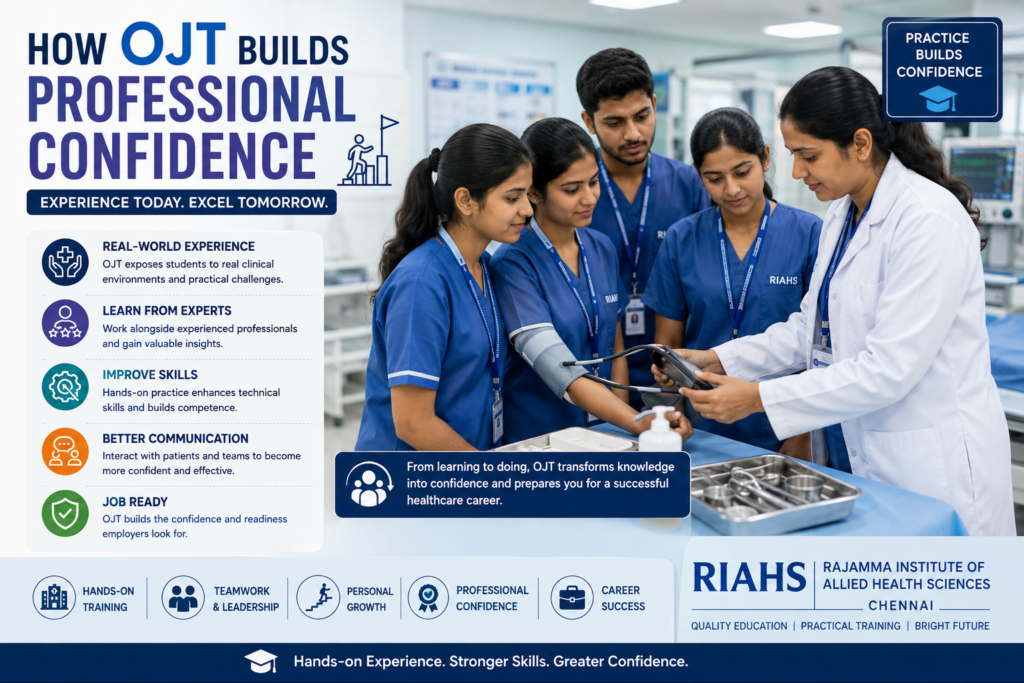
How OJT Develops Professional Confidence
Academic classroom learning acts as a base for a successful career, but it is at the time of implementation that professional development starts. Students get an opportunity to practice the theoretical knowledge acquired in classroom through On-the-Job Training (OJT).
OJT is one of the most important things for allied healthcare courses students because it not only increases the technical skills but also builds confidence and communication skills in students. The On-the-Job Training program at Rajamma Institute of Allied Health Sciences (RIAHS), Chennai prepares the students for the real healthcare environment.
What Is On-the-Job Training (OJT)?
It is a type of training wherein the student gets practical knowledge in hospitals, clinics, diagnostic center or other healthcare facilities along with the experienced doctors, nurses and healthcare professionals.
As compared to classroom lesson, On-the-Job Training allows the students to do the following activities:
- See how the healthcare procedures take place
- Use medical instruments and tools
- Communicate with the patients
- Get familiar with the hospital rules and regulations
- See how the clinical procedure takes place
- Develop professional behavior
Thus, it gives practical experience to the students.
Why Professional Confidence Is Important
Healthcare professionals operate in an environment where efficiency, responsibility, and the timeliness of actions directly affect patients. Confidence allows students to accomplish actions easily, communicate, and adapt to any situation.
Professional confidence helps to:
- Be proactive
- Find effective solutions
- Work under pressure
- Cooperate with healthcare teams
- Provide better patient care
- Grow professionally quickly
OJT creates an environment for developing these traits.
How OJT Helps Students to Develop Professional Confidence
1. Converting Theoretical Knowledge Into Practical Skills
It is useful to study different procedures on paper, but actually doing them under supervision increases confidence. During OJT, students learn to apply theoretical knowledge in practice.
2. Getting Experience from Qualified Healthcare Professionals
The main benefit of OJT is to interact with qualified healthcare professionals. Students can see how experienced doctors, nurses, and technicians treat patients, deal with emergencies, and demonstrate professional behavior.
Learning directly from the specialists makes it possible to learn industry standards and be more confident in one’s skills.
3. Developing Good Communication Skills
Communication is what healthcare professionals do daily with their patients, families, doctors, nurses, and other administrative staff.
With OJT, students get experience in:
- Communicating with patients
- Professional communication
- Listening
- Coordination of Team Coordination
- Documentation Practices
Such practices will make future workplace communication much easier.
4. Understanding Workplace Discipline
Professional self-confidence also arises from understanding workplace expectations.
Students acquire:
- Time Management
- Professional Ethics
- Hospital Procedures
- Infection Control Measures
- Personal Grooming Standards
- Workplace Responsibility
Such practices acquired during education help students have a successful career in the future.
5. Developing Decision Making Skills
Fast-thinking and decision making are some of the qualities of a good healthcare provider.
Through supervised training, students learn how to:
- Manage Tasks
- Deal with Emergencies
- Follow Healthcare Protocols
- Efficiently Help Health Care Teams
Each successful experience increases confidence in dealing with future responsibilities.
6. Getting Comfortable with Medical Technology
Modern healthcare heavily depends on various medical technologies.
In OJT, students get hands-on practice with:
- Patient Monitoring Systems
- Laboratory Equipment
- Diagnostic Devices
- Surgical Instruments
- Hospital Software
- Emergency Devices
Regular hands-on practice reduces hesitation and makes students technically competent.
7. Learning Teamwork
Hospitals run because of cooperation of several healthcare professionals.
OJT helps students learn how to:
- Work with Physicians
- Help Nurses
- Help Technicians
- Communicate with Administrative Personnel
- Participate in patient care as a part of a team
Knowledge of team dynamics helps students feel confident.
8. Managing Patients
Dealing with 8. Dealing With Actual Patient Scenarios
Interacting with real patients is an important learning experience for students.
Students gain confidence in their ability to:
- Deal with patients appropriately
- Maintain confidentiality
- Describe routine procedures
- Provide psychological support
- Cater to varying patient needs professionally
These learning experiences help students become empathetic healthcare professionals.
9. Getting Constructive Criticism
In OJT, supervisors evaluate the performance of students regularly and offer guidance on areas of improvement.
Constructive criticism helps students improve by:
- Pointing out their mistakes
- Improving their technical abilities
- Enhancing their professional behavior
- Gaining confidence through consistent learning
Each area of improvement contributes towards enhancing workplace preparedness.
10. Workplace Preparedness
Recruiters favor those who have work experience in hospital settings.10. Workplace Preparedness
Recruiters favor those who have work experience in hospital settings.
Students who have completed OJT usually possess:
- Practical experience
- Workplace discipline
- Interview confidence
- Improved technical knowledge
- Ability to adapt quickly
This helps them compete in the job market.
Advantages of OJT for Healthcare Students
On-the-Job Training allows students to:
- Gain practical experience
- Become self-confident
- Improve communication skills
- Know about hospital processes
- Improve technical skills
- Acquire professional etiquette
- Build leadership skills
- Increase chances of employment
- Be ready for long-term career growth
Career Options Students graduating from healthcare courses through OJT will be able to pursue their careers in:
- Multi-specialty hospitals
- Diagnostic labs
- Operation theaters
- Emergency care units
- Clinics
- Rehabilitation centers
- Medical colleges
- Specialized healthcare units
The practical knowledge acquired by students through OJT makes them better candidates for these jobs.
Why Study at RIAHS Chennai?
Rajamma Institute of Allied Health Sciences (RIAHS) feels that practical learning leads to professional success. RIAHS combines classroom learning with industry training so that students can develop into confident health care professionals.
Students get the following benefits at RIAHS:
- Experienced faculty members
- Practical laboratory sessions
- OJT in hospitals
- Industrially oriented curriculum
- State-of-the-art facilities for learning
- Professional skill development
- Career counseling
- Job placement
FAQs
1. What is On-the-Job Training (OJT)?
OJT involves practical learning, whereby students acquire practical knowledge in actual healthcare institutions guided by professionals.
2. Why is OJT important for healthcare students?
OJT helps students develop skills, communication, understand hospital functioning and gain professional confidence.
3. Does OJT increase job opportunities?
Yes, since employers prefer candidates with practical training as they can easily fit into their job roles.
4. What skills do students develop in OJT?
Students get trained on technical skills, communication, team work, problem solving, time management and professional ethics.
5. Why should I join RIAHS Chennai?
RIAHS will help you through quality education, practical hospital training, experienced tutors, career counseling and placement services.