Pathology Lab Careers
Reflect on the last visit that one of your relatives made for a medical examination. Blood test or urine test or any other test could be prescribed. Within no time, an elaborate report would be available for the doctor. While everybody pays attention to the diagnosis, very few consider the hard-working professionals behind the reports.
The pathology lab is where science meets medicine. Each and every sample that is processed in this laboratory must be done so precisely since an error could impact the care given to the patient. This makes Clinical Pathology an interesting subject to study for those who enjoy science and practical subjects as well as paying close attention to details.
In the Rajamma Institute of Allied Health Sciences (RIAHS), which is part of the Rajamma Medical Foundation (RMF), students are taught laboratory science by practical training, making them aware of the duties and skills needed to work in a modern diagnostic laboratory.
Inside a Modern Pathology Laboratory
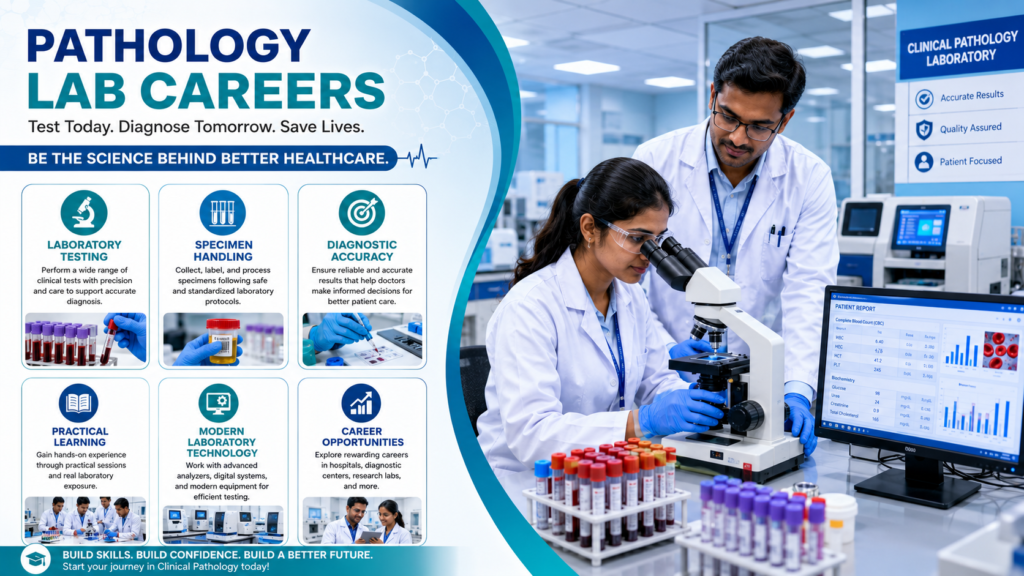
Pathology laboratory is a very busy place where each task is done in a systematic way. Laboratory technicians work meticulously to make sure each sample is properly processed from start to finish.
The activities performed include:
- Receiving and organising specimens
- Preparing samples for testing
- Maintaining laboratory records
- Following infection control measures
- Supporting diagnostic procedures
- Maintaining laboratory equipment
These are some of the daily activities.
Practical Experience Builds Confidence
It becomes much easier for the students to move from theoretical classes to actual laboratories if they get practical experience while studying.
This is done at RIAHS through the practical learning sessions where students are able to:
- Observe professional laboratory procedures
- Understand laboratory safety protocols
- Improve technical confidence
- Learn workplace discipline
- Develop professional communication
By actually doing things, the students become more confident about laboratory duties.
Technology Is Transforming Laboratory Science
Modern diagnostic laboratories rely on technology to increase their efficiency and accuracy.
The students are made familiar with instruments like:
- Automated laboratory analyzers
- Microscopes
- Digital reporting systems
- Sample processing equipment
- Laboratory information systems
Knowing how modern laboratories work helps the students get ready for the professional environment of health care.
Skills That Help Students Succeed
An effective laboratory professional not only has knowledge but the proper attitude as well.
During the process of education, students develop valuable qualities such as:
- Accuracy
- Observation
- Communication
- Teamwork
- Professional ethics
- Time management
These skills will help students adjust to various laboratory environments and still retain professional quality.
Why Students Choose RIAHS
It is essential that the choice of the institute will help in obtaining valuable skills in the field of healthcare.
At Rajamma Institute of Allied Health Sciences (RIAHS), students benefit from:
- Experienced faculty members
- Practical laboratory sessions
- On-the-Job Training (OJT)
- Modern laboratory facilities
- Career-oriented curriculum
- Student-focused guidance
The programme is developed in such a way that it helps students develop their confidence and at the same time learn about professional pathology laboratories.
Take the First Step Towards a Laboratory Career
Clinical Pathology allows students to gain practical skills while participating in one of the crucial support systems of the healthcare sector. The field is highly interesting for those students who like sciences and practical activities.
In order to learn more about the Clinical Pathology programme, admissions and eligibility criteria, please complete the contact form at the RIAHS official website. Our admissions staff will gladly help you.
Frequently Asked Questions
1. What is a pathology laboratory?
Pathology Laboratory is a health facility, where the patient specimens are studied in order to diagnose and treat diseases.
2. What do students learn in Clinical Pathology?
Students gain knowledge on how to perform laboratory tests, handle specimens, work with equipment, follow the rules of conducting laboratory procedures.
3. Why is practical laboratory training important?
Practical training will enable the students to practice theoretical knowledge and skills, and also build their confidence level in laboratories.
4. Does RIAHS provide On-the-Job Training?
Yes. RIAHS provides On-the-Job Training (OJT) for students in order to give them practical experience in laboratories.
5. Who can apply for the Clinical Pathology programme?
The students who have passed the 10th, 12th (whether passed or failed), or any degree can contact RIAHS for admission.