Practical Learning vs Traditional Learning
Healthcare education has changed significantly over the years. While traditional classroom learning continues to play an important role in building medical knowledge, today’s healthcare industry expects graduates to have practical skills, professional confidence, and real-world experience before entering the workforce.
Healthcare professionals work in environments where every decision and action can affect patient care. This is why employers prefer candidates who have both strong theoretical knowledge and hands-on training.
Rajamma Institute of Allied Health Sciences (RIAHS), a unit of Rajamma Medical Foundation (RMF), follows a career-focused approach by combining classroom education with practical learning. This balanced method helps students become skilled, confident, and ready for professional healthcare careers.
Understanding Traditional Learning
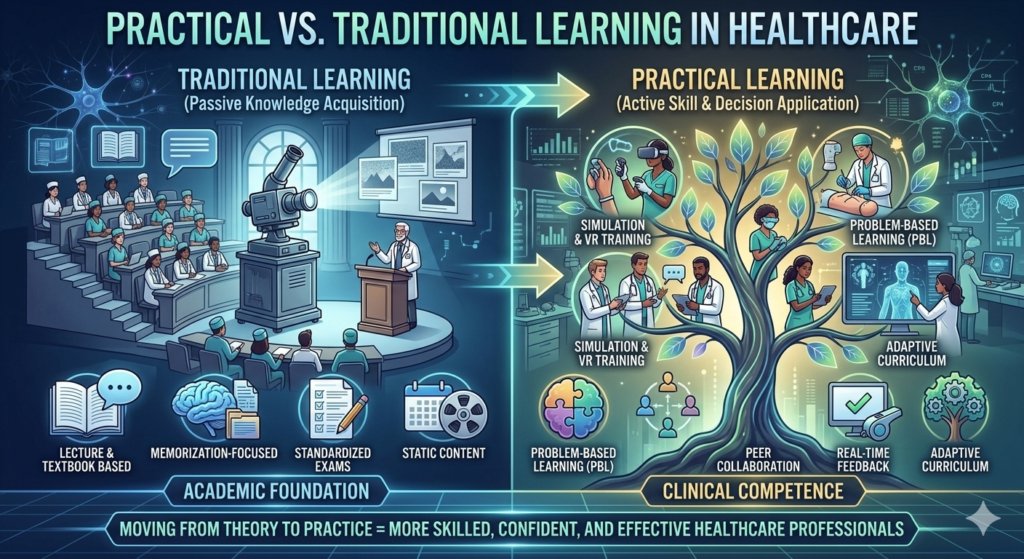
Traditional learning focuses on academic education through classroom lectures, textbooks, assignments, and examinations. It provides students with the essential knowledge required to understand healthcare concepts and medical sciences.
Students learn about:
- Human anatomy and physiology
- Medical terminology
- Healthcare procedures
- Disease prevention
- Patient care principles
- Professional ethics
This theoretical foundation is essential because it helps students understand why healthcare procedures are performed and how different medical systems function.
However, theory alone is not enough to prepare students for real healthcare responsibilities.
The Importance of Practical Learning
Practical learning allows students to apply classroom knowledge in real or simulated healthcare environments. Instead of simply reading about medical procedures, students gain experience by performing healthcare-related tasks under expert supervision.
At Rajamma Institute of Allied Health Sciences (RIAHS), practical learning is an integral part of every program.
Students participate in:
- Laboratory practical sessions
- Clinical demonstrations
- Medical equipment handling
- Patient care practice
- Healthcare simulations
- Skill development workshops
These experiences help students develop confidence while improving their technical abilities.
Why Practical Learning Makes a Difference
Healthcare professionals need more than academic knowledge. They must be able to communicate effectively, work as part of a team, operate medical equipment, and respond confidently in healthcare settings.
Practical learning helps students:
- Improve technical skills
- Build professional confidence
- Understand workplace expectations
- Develop communication skills
- Strengthen teamwork
- Improve problem-solving abilities
These qualities prepare students for successful healthcare careers.
On-the-Job Training Enhances Learning
One of the major advantages at RIAHS is On-the-Job Training (OJT) for Advanced Diploma students.
OJT provides valuable workplace exposure where students observe healthcare professionals, participate in supervised clinical activities, and experience the daily functioning of healthcare facilities.
Through OJT, students learn to:
- Apply theoretical knowledge
- Understand hospital operations
- Communicate with healthcare teams
- Develop professional discipline
- Gain practical industry experience
This hands-on exposure helps students transition smoothly from education to employment.
Combining Theory and Practice
At Rajamma Institute of Allied Health Sciences (RIAHS), students benefit from a balanced educational approach that combines traditional learning with practical training.
This includes:
- Classroom instruction
- Practical laboratory sessions
- Clinical demonstrations
- Healthcare simulations
- On-the-Job Training (OJT)
- Faculty mentorship
By integrating both methods, students graduate with the knowledge and practical skills needed in today’s healthcare industry.
Preparing Students for Career Success
Healthcare employers look for professionals who can contribute from the very beginning of their careers. Students with practical experience are often more confident and adaptable in professional settings.
Graduates from RIAHS can pursue careers in:
- Multi-speciality Hospitals
- Diagnostic Laboratories
- Clinical Laboratories
- Retail and Hospital Pharmacies
- Operation Theatres
- Rehabilitation Centres
- Healthcare Clinics
- Community Healthcare Services
The institute also provides career guidance and placement assistance to help students begin their professional journey.
Why Choose RIAHS?
Students choose Rajamma Institute of Allied Health Sciences (RIAHS) because the institute prepares them for real healthcare careers through quality education and practical experience.
RIAHS offers:
- Career-oriented Diploma and Advanced Diploma programs
- Practical laboratory training
- Clinical demonstrations
- On-the-Job Training (OJT)
- Experienced faculty
- Modern laboratory facilities
- Career counselling
- Placement assistance
This student-centred learning approach ensures graduates are prepared for the evolving healthcare industry.
Conclusion
Traditional learning builds the knowledge needed to understand healthcare, while practical learning develops the confidence and technical skills required in professional environments. Together, they create a complete educational experience that prepares students for long-term success.
Rajamma Institute of Allied Health Sciences (RIAHS), a unit of Rajamma Medical Foundation (RMF), combines academic excellence with hands-on learning to help students become competent, compassionate, and career-ready healthcare professionals.
Frequently Asked Questions (FAQs)
1. What is traditional learning in healthcare?
Traditional learning focuses on classroom teaching, textbooks, lectures, and theoretical knowledge of healthcare concepts.
2. Why is practical learning important in healthcare?
Practical learning helps students develop technical skills, confidence, and real-world experience, making them better prepared for healthcare careers.
3. Does RIAHS provide practical training?
Yes. RIAHS provides laboratory practical sessions, clinical demonstrations, healthcare simulations, and On-the-Job Training (OJT) for Advanced Diploma students.
4. How does On-the-Job Training (OJT) benefit students?
OJT gives students supervised experience in healthcare settings, helping them understand workplace responsibilities, improve communication, and gain practical skills.
5. Why choose Rajamma Institute of Allied Health Sciences (RIAHS)?
RIAHS, a unit of Rajamma Medical Foundation (RMF), offers career-focused education, practical learning, experienced faculty, modern facilities, career guidance, and placement support to prepare students for successful healthcare careers.