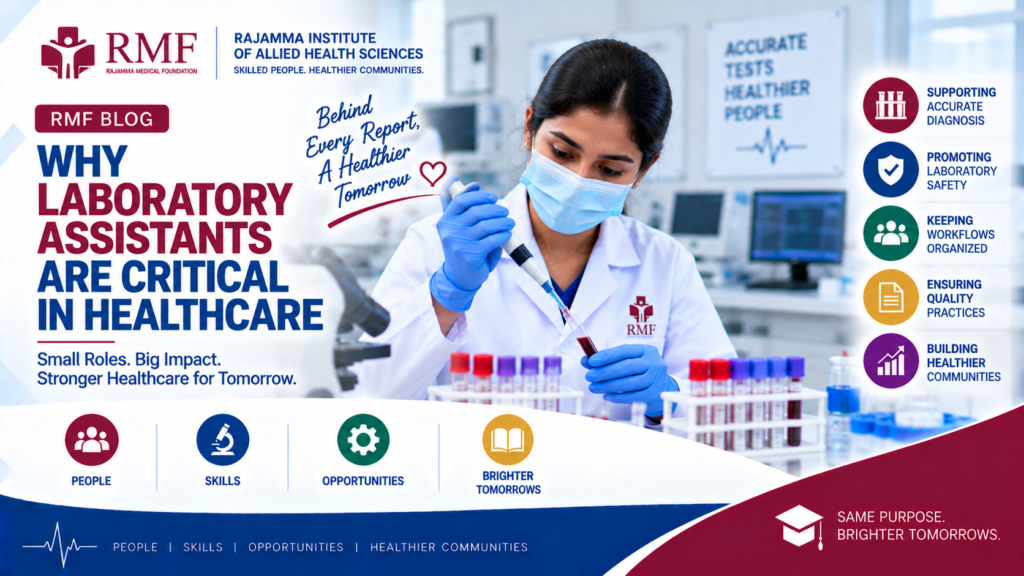
Why Laboratory Assistants Are Critical in Healthcare
Laboratory testing is an important aspect of modern healthcare. Doctors and other healthcare professionals rely on laboratory information alongside a patient’s history examination and other clinical findings to assess health conditions and plan care.
Behind many laboratory investigations is a team of professionals who help ensure that specimens are received handled processed documented and managed correctly.
Laboratory assistants play an important supporting role in this process.
Their work may not always be visible to patients but careful laboratory support can contribute to efficient workflows specimen quality safety and reliable laboratory operations.
What Does a Laboratory Assistant Do?
A laboratory assistant supports day-to-day activities within a laboratory according to their training qualifications and workplace responsibilities.
Depending on the laboratory setting responsibilities may include:
- Receiving and organising laboratory specimens
- Supporting sample processing
- Labelling and documentation
- Preparing materials and equipment
- Maintaining laboratory work areas
- Following safety procedures
- Supporting routine laboratory workflows
- Maintaining records
- Assisting laboratory professionals with assigned tasks
The exact responsibilities can vary between hospitals diagnostic laboratories pathology laboratories and other healthcare settings.
Why Are Laboratory Assistants Important?
Laboratories depend on organised workflows to process large numbers of specimens efficiently.
A laboratory assistant can help keep these workflows organised by supporting activities that take place before during and after laboratory testing.
Small errors in areas such as identification labelling documentation or sample handling can affect laboratory processes making attention to detail an important quality for anyone working in a laboratory environment.
Laboratory assistants therefore contribute to the overall functioning of the laboratory team.
Supporting Accurate Sample Handling
Specimen handling is one of the important areas of laboratory work.
Samples need to be handled according to the procedures applicable to the type of specimen and test. Appropriate handling helps maintain specimen quality and supports subsequent laboratory processes.
Laboratory assistants may support activities such as:
- Receiving specimens
- Checking required information
- Labelling samples appropriately
- Organising specimens
- Preparing samples for assigned processes
- Following storage and transport requirements
- Maintaining documentation
Proper procedures are particularly important as laboratory testing depends on the quality and integrity of the specimen being examined.
The Importance of Laboratory Safety
Safety is essential in every healthcare laboratory.
Laboratory personnel may work around biological specimens chemicals equipment and potentially hazardous materials. Following established safety procedures helps protect staff and maintain a safe working environment.
Important practices can include:
- Appropriate use of personal protective equipment
- Hand hygiene
- Safe handling of specimens
- Correct disposal of laboratory waste
- Safe handling of sharps
- Following laboratory safety protocols
- Maintaining clean and organised work areas
- Reporting incidents or problems through appropriate procedures
Safety awareness should become part of professional laboratory practice from the beginning of a student’s education and training.
Supporting Laboratory Professionals
Laboratory assistants work as part of a broader healthcare and laboratory team.
Depending on their role and workplace they may support medical laboratory professionals by helping with routine processes and maintaining an organised working environment.
Effective teamwork requires:
- Clear communication
- Following instructions
- Accurate documentation
- Respect for professional responsibilities
- Cooperation with colleagues
- Awareness of laboratory procedures
A well-coordinated laboratory team can help maintain smoother workflows and support efficient healthcare services.
Documentation and Record Keeping
Laboratory work involves significant amounts of information and documentation.
Accurate records can help laboratories track specimens processes and other relevant activities.
Laboratory assistants may be involved in documentation according to their assigned responsibilities.
Attention to detail is particularly important when recording information as incorrect or incomplete documentation can create problems for laboratory workflows.
Developing good documentation habits is therefore an important part of laboratory training.
Laboratory Assistants and Quality Practices
Quality is an essential part of laboratory services.
Laboratory assistants contribute to quality by following established procedures and performing their assigned responsibilities carefully.
Important quality-related habits include:
- Following standard operating procedures
- Checking information carefully
- Handling specimens correctly
- Maintaining proper documentation
- Following equipment procedures
- Reporting problems appropriately
- Maintaining cleanliness and organisation
- Following safety requirements
Quality is not limited to the final laboratory result it involves consistent practices throughout the laboratory workflow.
The Role of Technology in Modern Laboratories
Modern laboratories increasingly use automated equipment digital systems and advanced diagnostic technologies.
Technology can improve efficiency and support laboratory workflows but trained personnel are still needed to operate systems appropriately and manage processes around them.
Laboratory assistants may therefore need familiarity with:
- Laboratory equipment
- Computerised systems
- Sample tracking processes
- Digital documentation
- Automated workflows
- Basic laboratory technology
Technology skills can become increasingly valuable as healthcare laboratories continue to modernise.
Skills Every Laboratory Assistant Should Develop
A successful laboratory assistant needs more than technical knowledge.
Attention to Detail
Laboratory work requires careful attention to specimen information labels documentation and procedures.
Communication Skills
Clear communication helps laboratory teams coordinate their work and address issues appropriately.
Teamwork
Laboratory services depend on professionals working together towards a common goal.
Safety Awareness
Understanding and following safety procedures is essential in a healthcare laboratory.
Technical Skills
Knowledge of laboratory equipment and routine procedures can help professionals perform their assigned responsibilities effectively.
Organisation
Laboratories handle multiple specimens and processes. Good organisational skills can help maintain efficient workflows.
Willingness to Learn
Laboratory technology and procedures continue to develop. Professionals should be prepared to update their knowledge and skills.
Where Can Laboratory Assistants Work?
Depending on their qualifications training and applicable employment requirements laboratory assistants may find opportunities in different healthcare environments.
Potential workplaces can include:
- Hospitals
- Diagnostic laboratories
- Pathology laboratories
- Medical colleges
- Research laboratories
- Healthcare organisations
- Diagnostic centres
- Other laboratory-based healthcare settings
Career opportunities and job responsibilities can vary depending on the employer qualification and applicable professional requirements.
Why Practical Training Matters
Laboratory education becomes more meaningful when students can connect theoretical concepts with practical laboratory activities.
Practical training can introduce students to areas such as:
- Laboratory equipment
- Specimen handling
- Laboratory safety
- Documentation
- Routine workflows
- Sample processing
- Quality practices
Practical exposure can also help students become more comfortable working in an organised laboratory environment.
Career Growth in Laboratory Healthcare
Healthcare continues to depend on laboratory investigations across many areas of patient care research and public health.
As laboratories adopt automation digital systems and advanced diagnostic technologies the working environment is also changing.
This creates a need for professionals who understand laboratory fundamentals and can adapt to evolving technologies and procedures.
For students interested in laboratory careers building strong fundamentals practical skills and professional discipline can provide a useful foundation for future development.
Laboratory Education at Rajamma Institute of Allied Health Sciences
Rajamma Medical Foundation (RMF) through Rajamma Institute of Allied Health Sciences focuses on developing skilled ethical and future-ready healthcare professionals through quality education and practical training.
For students interested in laboratory and clinical pathology-related careers combining theoretical learning with practical exposure can help develop important workplace skills.
Training that emphasises technical knowledge laboratory safety attention to detail communication and continuous learning can help students prepare for professional laboratory environments.
Building a Career as a Laboratory Assistant
Laboratory assistants are an important part of the healthcare laboratory team. Their responsibilities support the organised movement and handling of specimens documentation safety and routine laboratory workflows.
The role requires responsibility accuracy and a strong understanding of laboratory procedures.
Students considering this career path can focus on developing:
- Strong laboratory fundamentals
- Practical skills
- Safety awareness
- Attention to detail
- Communication skills
- Teamwork
- Professional discipline
- Continuous learning
With healthcare laboratories becoming increasingly technology-driven laboratory assistants who combine practical competence with adaptability can be better prepared for changing workplace requirements.
Frequently Asked Questions
1. Why are laboratory assistants important in healthcare?
Laboratory assistants support important laboratory activities such as specimen handling documentation safety practices and routine workflows helping laboratories operate in an organised manner.
2. What are the main responsibilities of a laboratory assistant?
Responsibilities can vary by workplace but may include specimen handling documentation preparing materials maintaining work areas following safety procedures and supporting assigned laboratory processes.
3. What skills are important for laboratory assistants?
Important skills include attention to detail laboratory knowledge safety awareness communication teamwork organisation technical ability and willingness to learn.
4. Where can laboratory assistants work?
Depending on their qualifications and employment requirements laboratory assistants may work in hospitals diagnostic laboratories pathology laboratories medical colleges research laboratories and other healthcare settings.
5. How can students prepare for a laboratory assistant career?
Students can prepare through relevant laboratory education practical training equipment exposure safety education and development of technical and professional skills.